Dagfinn Føllesdal, philosopher known as a ‘builder of bridges,’ dies at 93
A passionate and wide-ranging scholar, the Norway-born professor reconciled two disparate philosophical traditions.
Dagfinn Føllesdal, the Clarence Irving Lewis Professor of Philosophy, Emeritus, in the Stanford School of Humanities and Sciences (H&S) and a wide-ranging philosopher known for bridging traditions, died March 1, 2026. He was 93.
Born and educated in Norway, Føllesdal arrived at Stanford in 1968 and earned a reputation as a serious scholar who could synthesize disparate philosophical beliefs, most notably the analytic and continental traditions. He published prolifically on a variety of topics and philosophers, ultimately earning membership in the American Academy of Arts and Sciences, as well as prestigious organizations in his homeland.
“Dagfinn Føllesdal was a gifted philosopher and a wonderful human being,” said John Perry, the Henry Waldgrave Stuart Professor of Philosophy, Emeritus, in H&S, who recalled in an oral history that Føllesdal hired him at Stanford. “He simply understood things well, whether the works of a long-dead philosopher or the ideas—profound or confused—of a colleague or student. There was no one better to talk philosophy with; I miss him greatly.”
‘Exemplar of what a philosophy professor should be’
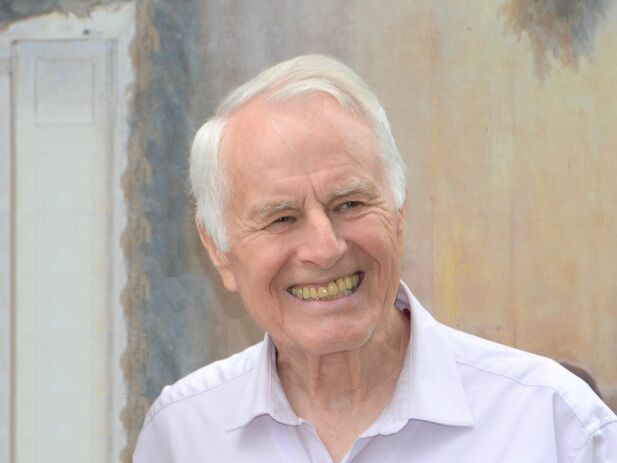
In a description for a University of Oslo workshop on his oeuvre, Føllesdal is described as a “builder of bridges.” This stems from his work reconciling the so-called analytic and continental traditions in philosophy—that is, the largely Anglo-American tradition (analytic) and that of Europe (continental). To do this, he drew on his extensive knowledge of such thinkers as the Austrian German Edmund Husserl (a continental philosopher), Gottlob Frege (a German analytic), and the Americans Donald Davidson and W.V.O. Quine, who was Føllesdal’s mentor. The result connected the philosophies of language and phenomenology, logic and mathematics.
“As both a colleague and a teacher, Dagfinn combined great personal grace, warmth, generosity, and supportiveness with a demanding insistence on rigor and clarity,” said Michael E. Bratman, the U.G. and Abbie Birch Durfee Professor and professor of philosophy in H&S. “He was justly famous for bringing together the two traditions, and that bridge played a major role in philosophy during the second half of the 20th century and beyond, both at Stanford and internationally.”
Bratman also noted that Føllesdal himself was a bridge: “He helped in many ways to connect the research and teaching activities at Stanford with work in Norway and other parts of Europe.”
Føllesdal wrote or edited more than 25 books during his long career, in addition to hundreds of articles on a range of philosophical subjects. He was also the editor of the Journal of Symbolic Logic from 1970 to 1982. His professional honors include membership in the Norwegian Academy for Language and Literature, the Norwegian Academy of Science and Letters (where he was president from 1993 to 1997), and the Royal Swedish Academy of Sciences. In 2009, Føllesdal was named a Commander of the Royal Norwegian Order of St. Olav by the King of Norway.
“Dagfinn Føllesdal was one of my first teachers at Stanford and one of the reasons I went into philosophy,” said Leif Wenar, the Olive H. Palmer Professor of Humanities and professor of philosophy in H&S. “He showed us undergraduates how even the most obscure ideas could yield deep insights when analyzed rigorously—and often did so with the delicate touch of good humor. He was also such a deeply decent and caring man. To so many of us, he was an intellectual and personal exemplar of what a philosophy professor should be.”
An early fascination with philosophy
Born in Askim, Norway, in 1932, Føllesdal earned his doctorate in philosophy from Harvard in 1961, after studying under Quine. He joined Stanford in 1968, when longtime Stanford professor Patrick Suppes—whom Føllesdal had never met before—asked him to come to the university after hearing a talk Føllesdal gave in Jerusalem.
Throughout his time at Stanford, he remained a professor at the University of Oslo, an arrangement that meant he taught at Stanford during the summer and spent the rest of the year in his home country. His wife, Vera, and their six children—five born during his seven years studying and teaching at Harvard—traveled with them. “We left [Norway] the day school ended and came back the day school started,” he said in a 2020 interview with Scandinavian University Press.
In that interview, he also recalled his upbringing as the first child of teachers whose book collection included Hermann Weyl’s Philosophy of Mathematics and Natural Science, which he credited for piquing his interest in philosophy. “It fascinated me,” he said in the interview. “Weyl’s combination of mathematics, physics, and Husserlian philosophy has continued to appeal to me through my whole life.”
Throughout his life, he also participated in orienteering, a sport in which players seek to run from location to location in unknown territory using only a compass and a map; he played into his late 80s.
Asked in the 2020 interview what the meaning of life is, Føllesdal was characteristically philosophical: “Maybe the meaning of life is to understand a little better these fundamental issues that are so important in so many fields but in particular in the relations of humans to one another,” he said. “Maybe.”
Føllesdal is survived by his sister, five children, 12 grandchildren, and four great-grandchildren. His wife, Vera, died in 2021. A service was held March 11 at St. Dominikus Catholic Church in Oslo, followed by a funeral reception at the Norwegian Academy of Science and Letters.

New undergraduate minor launches in civic thought and practice
Adrien Bilal selected for Time100 Next

Peter M. Ray, biologist with a passion for winemaking, has died at 94