Econometrician Takeshi Amemiya has died
One of the most influential econometricians of the last century, the groundbreaking Stanford professor harnessed statistical models to understand economic data, transforming the field of theoretical econometrics.
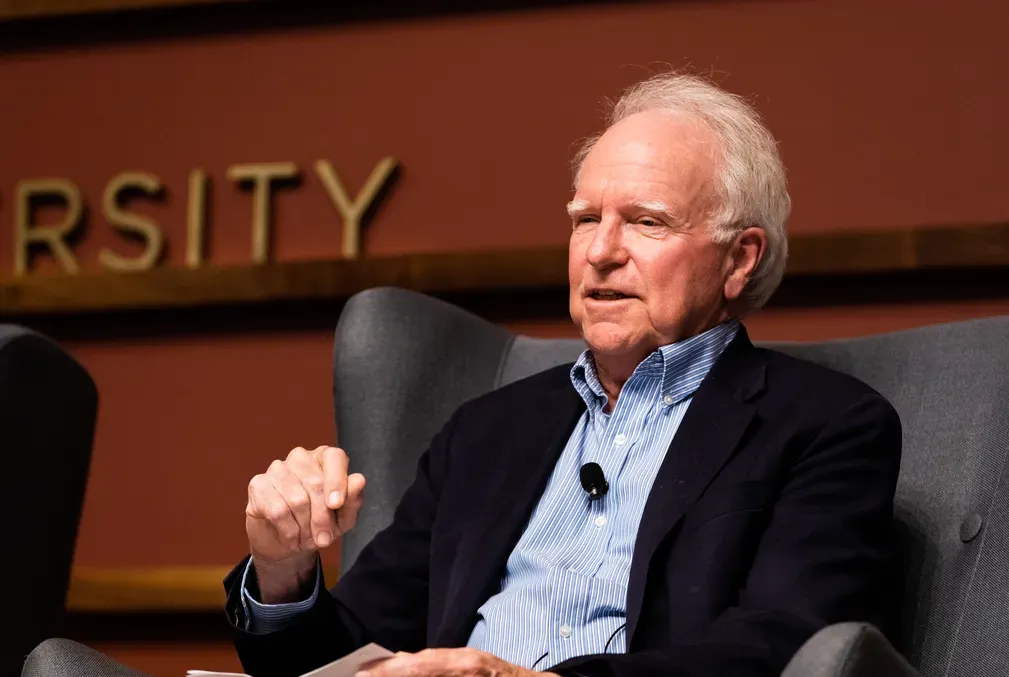
Takeshi Amemiya, the Edward Ames Edmonds Professor of Economics, Emeritus, in the Stanford School of Humanities and Sciences (H&S), died Feb. 25, 2026, at his campus home. He was 90. His work defined modern econometrics, which uses statistical methods and mathematical modeling to inform economic theory.
Amemiya’s body of scholarship was shaped by curiosity, discipline, and seriousness. His 1985 book, Advanced Econometrics, became an authoritative reference text and is still required reading at universities around the world. He worked on estimation of nonlinear econometric models including those for qualitative response, censored and truncated dependent variables, and transformed regressions. These models turned into standard tools across empirical economic fields.
"He was the leading figure in econometric theory for the latter half of the last century,” said Frank Wolak, the Holbrook Working Professor in Price Theory and professor of economics in H&S. "Every econometrician in the last 50 years has read his papers and understood his foundational contributions."
His research combined mathematical rigor with illustrative clarity, earning him many honors such as membership in the American Academy of Arts and Sciences, the American Statistical Association, and the Econometric Society.
A humble professor with a hunger for knowledge
Amemiya joined Stanford in 1964 as an assistant professor of economics. In 1966, he moved to Tokyo to teach at the Institute for Economic Research at Hitotsubashi University, and while in Japan, he met his future wife, Yoshiko.
The couple returned to the United States in 1968 and raised two children while Amemiya helped build Stanford into one of the world’s leading centers for econometric theory. He helped forge many young minds who went on to become distinguished leaders in both academia and the public sector.
While his contributions were monumental, his approach was unpretentious. Amemiya's colleagues underscored the humility, depth, and breadth he brought to scholarly pursuits.
“What was amazing about him was his generosity and kindness,” said Han Hong, a professor of economics in H&S whom Amemiya advised as a doctoral student. “Even with how prominent he was, he was always willing to spend time with students and colleagues.”
Amemiya’s teaching style was marked by interaction and improvisation without foregoing technical prowess. In his Stanford 2017 oral history, he criticized the trends toward overly polished classroom environments as he embodied the opposite.
He tended to work with students to solve new problems during classroom lectures, underscoring his intellectual seriousness coupled with an aliveness for the process of discovery. His mode of scholarship was rooted in original thought and clarity, favoring precision and honesty over obscurity.
In Amemiya’s later years, his scholarship expanded beyond economics to the study of ancient Greece and connections between Greek and Japanese culture and mythology. He translated scholarly work on Aristotle’s ethics for Japanese readers and developed an undergraduate course called Economy and Economics of Ancient Greece, which became the basis for a book of the same name (Routledge, 2007). Amemiya retired from Stanford in March 2005 but continued teaching independent study and directed reading courses for many years.
“His intellectual curiosity was something to admire,” Hong said. “Even into retirement, he was still learning.”
Early travels and enduring legacy
Amemiya’s childhood was defined by resiliency. Born in Tokyo, Japan, in 1935, Amemiya moved to Peru at age 6 for his father’s job with a Japanese shipping company. Not long after, in 1942, Amemiya and his family were repatriated to Japan as part of a wartime exchange of Japanese and American civilians. They left Peru and traveled on boats, buses, and trains around the globe for several months before arriving in Japan.
Amemiya studied at International Christian University in Tokyo, where he polished his English and earned a bachelor's degree in economics. After graduating in 1958, he moved to the United States and studied at Guilford College in North Carolina and then American University in Washington, D.C., where he received a master's degree in economics in 1960.
He then earned a fellowship to pursue a doctoral degree at Johns Hopkins University, where he initially wanted to study socialist economics but was steered into econometrics. He finished his doctorate in 1964 under the guidance of Carl Christ, and later that year, he became an assistant professor in Stanford’s Department of Economics.
As a young professor in the 1960s, his focus shifted away from analyzing time series data—which involves concentrating on the same variable consistently across time—to the burgeoning field of cross-section data analysis. His theoretical and empirical work led to the publication of a series of foundational research articles that set new standards for nonlinear models, and these became some of the most cited econometrics articles of the 1970s. The work led to the publication of his book Advanced Econometrics.
His scholarship gave the discipline not only new results, but also a higher standard for precision and clarity, and he influenced colleagues and students across multiple generations. Amemiya also contributed substantially to the profession through his service as co-editor of the journal Econometrica from 1981 to 1982 and co-editor of the Journal of Econometrics from 1982 to 2010.
His trailblazing work earned him a Guggenheim fellowship in 1976, a fellowship from the Japan Society for the Promotion of Science in 1981, a Humboldt fellowship to study in Germany between 1988 and 1989, and a Tokyo University fellowship in 1989.
Beyond the classroom, Amemiya enjoyed playing tennis and traveling in his free time. And he was appreciated for his dry sense of humor: “Sometimes you'd walk away, and about five minutes later you'd realize what he'd meant and have a good laugh to yourself,” his colleague Wolak said.
Amemiya is survived by his wife of 57 years, Yoshiko; his daughter, Naoko; his son, Kenta; and four grandchildren, Gen, Emi, Kai, and Ryota.
Robert E. Hall wins Nobel in economics

New undergraduate minor launches in civic thought and practice

Adrien Bilal selected for Time100 Next