Worm’s radical transformation shows metamorphosis can change the functions of cells
A Stanford-led study of a marine worm’s metamorphosis found surprising signs that the original larval cells didn’t just die or assume the same role in the adult organism—most of them changed to serve another purpose.
In brief:
- The study revealed that the majority of larval cells in the marine worm Schizocardium californicum appeared to fundamentally transform in metamorphosis, against prior understanding of the process.
- Genetic sequencing of thousands of cells showed evidence of this cellular reprogramming, with larval nerve and gut cells taking on different functions in the adult.
- The findings are the strongest evidence yet of developmental reprogramming in bilaterally symmetrical animals, where one side of the body mirrors the other.
A squishy worm that starts its life as something of a floating head in the Pacific Ocean is changing what scientists know about metamorphosis at the cellular level.
Unlike humans, about 80% of animal species undergo metamorphosis, a stepped development from egg to larva to adult, but how it works at a cellular level is not well understood. Some theories and prior research suggested that the original cells in the larva die and are replaced with newly generated adult cells. Other work pointed to cells growing into their same function—for example, larval skin cells would become adult skin cells.
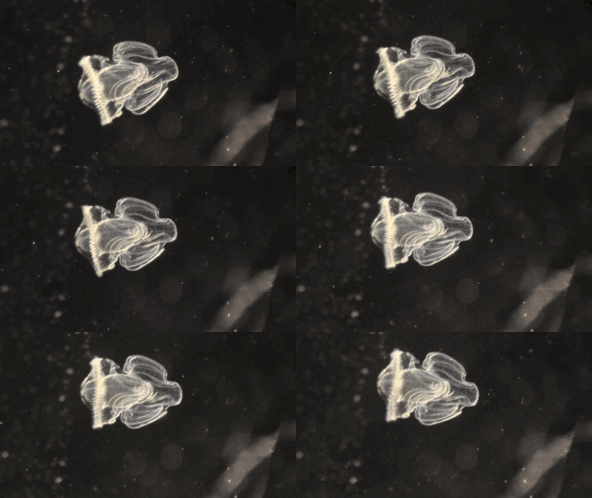
Instead, a Stanford-led study has found strong evidence in an acorn worm called Schizocardium californicum that most larval cells were reprogrammed, with even neurons taking on a new role in the adult organism.
“Reprogramming is a bit of an exotic fruit in developmental biology,” said Christopher Lowe, senior author on the study and biology professor in the Stanford School of Humanities and Sciences. “Generally, we used to think that as cells develop, they become increasingly restricted in their function. But when we start looking at more animals that go through metamorphosis, they may reveal that reprogramming is a much more common feature of development.”
Cellular reprogramming is thought to happen after an injury or in some species that regenerate organs or whole limbs—but not as a feature of normal development. This study, published in Nature Communications, is the first known research to suggest extensive cellular reprogramming during development in an animal with a bilateral body plan, where one side of the body matches the other, as in humans. Previous research has found some of this developmental type of reprogramming in sponges and jellyfish, two organisms that are far from humans on the evolutionary tree. In contrast, these acorn worms are part of the hemichordata phylum, considered an evolutionary link to vertebrate animals, including all mammals.
Following the cells
For this study, the team, led by first author Paul Bump, a former doctoral student in Lowe’s lab at Stanford’s Hopkins Marine Station, conducted genetic analyses on more than 87,000 cells from these acorn worms. The researchers performed single cell RNA sequencing on samples from worms in five developmental stages: early and late larvae, metamorphosis, and early and late juvenile. Using this information, they categorized the cells into 12 classes, such as cartilage, immune, and skin cells.
This analysis found that many larval cells were more similar to each other than they were to the adult cells performing the same function. For example, larval neurons were more like larval gut cells than they were to adult neurons. This was true for more than half of the cells, suggesting that there had been extensive reprogramming. There were some exceptions. For instance, the functions of muscle cells and mesoderm cells, which make up some organs, stayed the same from larval to juvenile stages.
Bump was also able to place a label—a type of persistent dye—on some larval cells before metamorphosis and follow them through the process to see that they persisted in the adult organism.
“This suggested that cells were not large-scale dying; they were actually being carried over,” Lowe said. “Based on their RNA sequence data, we saw that they had become very different in cell type, which was supportive of the idea that larval cells were being reprogrammed into new fates during metamorphosis, which goes against what most of the field would have predicted.”
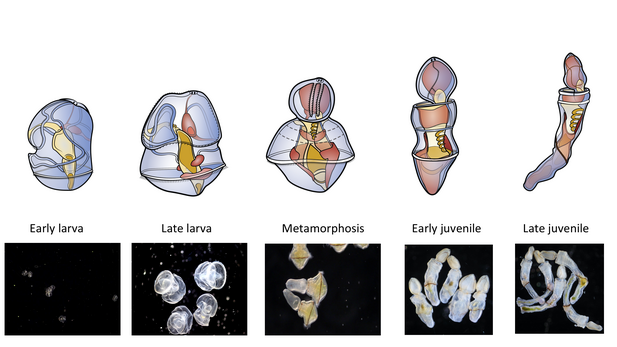
An unusual animal for an unusual discovery
Working with Schizocardium californicum was a challenge. This species is rarely used for research, which meant the scientists had to adapt tools and techniques normally used for other animals.
But the fact that this worm is not usually studied is exactly why it is of interest to Lowe's team. His lab specializes in “non-model” marine organisms as they may reveal more about not just their own development, but also the larger evolutionary history of many animals.
Most model organisms—the types of animals typically used in research, such as mice and zebra fish—are direct developers. They grow directly from an egg or embryo into an adult. These animals are more frequently studied partly because they are closer to humans genetically and partly because direct development is easier to manage in a lab.
Yet the focus on direct development leaves a huge gap in knowledge about the larger animal world, Lowe said, since so many animals are indirect developers that have a larval stage and undergo metamorphosis before growing into an adult.
The Schizocardium californicum worm also has a cousin that is a well-studied direct developer: Saccoglossus kowalevskii, sometimes called the Virginia acorn worm.
Key differences between the way the two acorn worms develop are apparent from observation. When the Virginia acorn worm hatches from an egg, it has the worm-like shape it will have its entire life, while the young larva of the Schizocardium californicum looks nothing like its adult form. This study also suggests that the California worm’s incredible transition is inside and out.
“You can watch this process of metamorphosis and see physically how things radically change, but this morphological transformation is also mirrored by a massive change in cellular components,” Lowe said.
Digging for insights: Conducting research on the Schizocardium californicum worm is challenging not just because it is understudied. It is also hard to find.
Native to the Pacific Coast, the adult worms live only in shallow tidal bays and often burrow more than a foot deep into the muddy sand. For this study, the researchers traveled to the closest open tidal flat, in Morro Bay. Then they got out their shovels.
The adult worms’ underground existence is dramatically different than their larval beginnings. When they first emerge from eggs that are laid in the top layer of mud, the larvae float in the ocean water as transparent, roundish blobs measuring a tenth of a millimeter (about 0.004 of an inch). They spend the first three months of their lives swimming and feeding on phytoplankton, which they push toward their mouths with cilia, hairlike structures that cover their skin in rows.
The larvae at this point are mostly just “swimming heads,” Lowe said. Through metamorphosis, they add long bodies and can grow as long as 3-4 millimeters (about 0.12-0.16 inches). They then use the nose-like points they have grown on their heads to burrow into the mud and filter feed. Video by Paul Bump.
Acknowledgments
Lowe is also the John B. and Jean De Nault Professor of Marine Science at the Hopkins Marine Station and a member of the Wu Tsai Neurosciences Institute and Bio-X. He is also an investigator at Chan Zuckerberg Biohub in San Francisco.
Bump is now an assistant professor at Pomona College.
Additional Stanford co-authors on the study include Laurent Formery, a former postdoctoral scholar, and Lauren Lubeck, a doctoral student, in Lowe’s lab.
Other co-authors include researchers affiliated with Baylor College of Medicine in Houston; Chan Zuckerberg Biohub in San Francisco; Johns Hopkins University; Stowers Institute for Medical Research in Kansas City, Missouri; and University of California, Berkeley.
This research received support from a Chan Zuckerberg Biohub Intercampus Research Award, the National Science Foundation, Myers Trust Award, and Haderlie Memorial Award.
Media contact:
Sara Zaske, School of Humanities and Sciences, 510-872-0340, szaske [at] stanford [dot] edu (szaske[at]stanford[dot]edu)
H&S adds 20 new faculty members
Sarah Peluse named Packard Fellow

Robert E. Hall wins Nobel in economics