Books in Brief
Mathematical Properties of Population-Genetic Statistics: Quadratic Forms Most Beautiful
Author: Noah A. Rosenberg
Via Princeton University Press
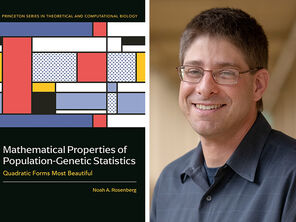
“Noah Rosenberg discusses how the behavior of these statistics depends not only on the biology of the populations they seek to describe but also on the mathematical properties of the functions used to compute them, properties that produce constraints on the values of the statistics and influence their interpretation. Focusing on the concept of homozygosity—a quadratic function of allele frequencies in a population—he demonstrates how to account for mathematical constraints when measuring genetic similarity and diversity. Rosenberg illustrates the results using examples from empirical data and shares strategies that readers can use to apply this mathematical perspective to different kinds of summary statistics, including those for measuring biodiversity in ecological communities."
Rosenberg is the Stanford Professor of Population Genetics and Society and a professor in the Department of Biology.