New book reflects artists’ perspectives on 1992 Los Angeles riots
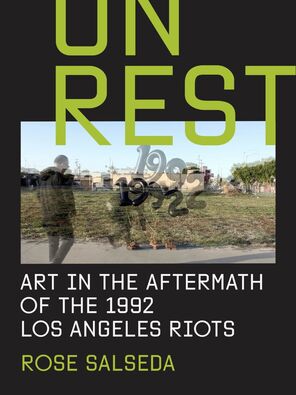
In Unrest: Art in the Aftermath of the 1992 Los Angeles Riots, art scholar Rose Salseda chronicles intergenerational, cross-racial experiences through the prism of art.
On April 29, 1992, a jury acquitted four White Los Angeles policemen of using excessive force in arresting Rodney King, a Black man whose beating at the officers’ hands was infamously captured on video. In response to the verdict, and within a broader context of long-running police brutality against minority communities, riots broke out across the city of Los Angeles. Looting, arson, and assault roiled the city for five days, culminating in more than 50 deaths and over a billion dollars in property damage.
Rose Salseda was 10 years old at the time, living in South LA “in the epicenter” of the riots, she recalled, where neighbors looted her block’s corner store. Huddled in a back room in her family’s home, she and her brothers watched in horror on TV as the city convulsed.
Now an assistant professor in the Department of Art and Art History in the Stanford School of Humanities and Sciences, Salseda has transmuted those experiences into her first book, Unrest: Art in the Aftermath of the 1992 Los Angeles Riots. Published this month by The University of Chicago Press, the book analyzes the multimedia works of four artists in response to the events. Two artists created their works in the immediate aftermath of the riots, while the other two, like Salseda, revisited their childhood experiences as adults. While exploring how their creations shine critical light on complex intergenerational and cross-racial currents, the book interweaves the artists’ and Salseda’s firsthand accounts.
We spoke with Salseda about the origins of her book and the continuing resonance of the LA riots in art and society.
This Q&A has been edited for clarity and length.
Question: Starting with the title, what does unrest mean, and how does it connect to artistic expression?
Salseda: In looking at the intergenerational legacy of the 1992 Los Angeles riots and how they affected the art world, it allowed me to rethink the concept of unrest as an act of the bereaved that makes injustice visible in the landscape for all to see. Unrest continues because of ongoing episodes of police brutality and injustices in the judicial system. Art can express insights unlike other methods of historical documentation, and the artworks and the stories that I cover in this book are experiences, especially from Latino and other immigrant communities, that weren't covered by mainstream press. These artists held those stories and then incorporated them into their artworks so that they could also be remembered.
Question: How did fellow Stanford scholars support you in this work?
Salseda: This book started as a project in grad school [at the University of Texas at Austin], and my adviser was Cherise Smith. She earned her PhD in art history here at Stanford, and she's also a fellow Los Angeleno. She was really the one who saw the potential and encouraged me to go for this book topic. At Stanford, my faculty mentor is Alexander Nemerov. Having a senior scholar like him—who also deeply feels the potential of art to hold not only history or politics, but also emotions—was important.
Question: What is an example of a piece of art discussed in the book that particularly captivated you?
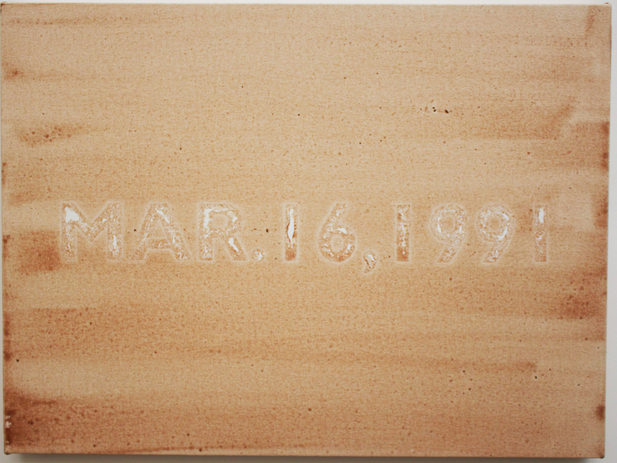
Salseda: Juan Capistrán’s renditions or reinterpretations of the date paintings by [Japanese artist] On Kawara, showing a date on a canvas. For this series of artworks, Capistrán collected his own tears and blood and used them to paint works related to the unrest. He, like me, is also from South Central Los Angeles. He was 15 at the time. As an adult, he started going back to this history, also like me. One of the paintings is dated March 16, 1991. That’s when a classmate of his, Latasha Harlins, was killed by a Korean shop owner. The owner accused this Black teenager of stealing a bottle of orange juice, and the owner shot her in the back of the head while she was walking away—after she put the bottle of orange juice on the counter. All of this was caught on surveillance camera, but the shop owner wasn't given any jail time for the murder. Everyone from community members to scholars pinpoints that killing as one of the incidents that led to the 1992 Los Angeles riots. In that particular painting, Capistrán included orange juice in the medium. The works seem minimalistic, which people might first perceive as being detached, but they’re so emotionally deep.
Question: What do you hope readers might take away from the book?
Salseda: I hope readers recognize not only the ongoing significance of the 1992 Los Angeles riots, but also how history is not neatly framed. These severe episodes of violence continue to resonate across time and across place. They shape art, but they also shape society. That's what these artists recognize.
Media contact:
Marijane Leonard, School of Humanities and Sciences
marijane [dot] leonard [at] stanford [dot] edu (marijane[dot]leonard[at]stanford[dot]edu)
New undergraduate minor launches in civic thought and practice
Adrien Bilal selected for Time100 Next
Peter M. Ray, biologist with a passion for winemaking, has died at 94