Researchers uncover evidence for sibling supernovas
Physicists have identified possible remnants of two exploded stars, or supernovas, that were once paired before they each blew up. The discovery was made in part by using data from the Fermi Large Area Telescope.
In brief
- Researchers have identified the remnants of a binary star system where two massive stars exploded sequentially.
- The study focused on the faint supernova remnant G189.6+3.3, which is largely overshadowed by another nearby remnant known as the Jellyfish Nebula.
- The findings were made possible through 16 years of data collected by NASA’s Fermi Gamma-ray Space Telescope, which carries instrumentation that was developed at Stanford and SLAC National Accelerator Laboratory.
Two stars once orbited each other in a binary star system until one of them exploded, sending its companion hurtling through space. Then, after traveling for thousands of years, the surviving star blew up, too.
This is the dramatic story suggested by a new study of supernova remnants, the debris left behind after stars explode. The analysis uncovered gamma rays associated with a supernova remnant that was hidden in the glare of its neighbor, the Jellyfish Nebula, one of the brightest gamma-ray-emitting supernova remnants known, said Miltiadis Michailidis, a physics postdoctoral scholar in the Stanford School of Humanities and Sciences.
“We’re looking at the final chapter of a relationship that began millions of years ago,” said Michailidis, who is the lead author on the study. “It is a binary star story with two massive stars that were bound together by gravity before they both exploded, and we can see the remnants.”
Unlike our solar system, with the sun as its singular star, the majority of star systems are binary, and this is the first known observation of a binary system where both stars have undergone supernova explosions.
The research used 16 years of data from NASA’s Fermi Gamma-ray Space Telescope. The space telescope is composed of two instruments, the Gamma-ray Burst Monitor and the Fermi Large Area Telescope. The latter was conceived and built by researchers at Stanford and SLAC National Laboratory, and Stanford continues to lead the collaborative research team for the Fermi LAT.
Michailidis presented the findings June 17 at the 248th meeting of the American Astronomical Society in Pasadena, California. A paper describing the results will appear in a future edition of Nature Communications.
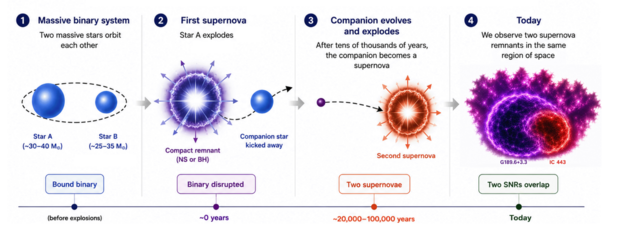
The study focused on a faint supernova remnant called G189.6+3.3, which is mainly visible in X-rays. It is upstaged by its brighter and better-known neighboring remnant, the Jellyfish Nebula (IC 443). The two star wrecks are both located in the constellation Gemini and appear to partially overlap, as seen in X-rays.
A massive star explodes when its energy-producing core runs out of fuel and collapses under its own weight, triggering an explosion that blows the star apart. The explosion’s shock wave encloses a hot cloud of debris that rapidly expands into space. So far, astronomers have cataloged about 300 supernova remnants in our galaxy.
In 2013, Fermi observations proved that the Jellyfish Nebula, which is interacting with part of a glowing cloud of hydrogen gas known as Sharpless 249, produced gamma rays through this mechanism. Its neighbor, G189.6+3.3, was discovered in 1994 as part of an X-ray survey by the German-led ROSAT (Roentgen Satellite) mission.
A bright filament of interstellar gas lies between the overlapping remnants. New observations of this feature reveal that the shock wave from the exploded G189.6+3.3 slammed into the dense gas and dramatically slowed.
“The overlapping remnants, a connecting gas filament, and the availability of data from Fermi and other facilities motivated us to delve into this complex but little-studied region,” said study co-author Marianne Lemoine-Goumard, an astrophysicist at the University of Bordeaux in France.
The team concluded that the remnants lie about 6,000 light-years away from Earth, and their explosion centers are separated by roughly 40 light-years projected onto the plane of the sky. The original stars may have been at least 20 times the Sun’s mass.
Estimates of the remnants’ ages vary widely, but the team estimated that the age of the Jellyfish Nebula is 8,000 to 9,000 years, while its sibling is 20,000 to 110,000 years old. This means the delay between the explosions could have been up to 100,000 years.
This story was adapted from a NASA press release.
Top image: This multiwavelength scene shows the Jellyfish Nebula supernova remnant (yellow cloud at right), the interstellar cloud it’s interacting with (the fainter cloud extending to the left and overlapping the top-right part of the nebula), and a distinctive curving gas filament, in violet, to its upper left. The filament, which is shown here both in optical and ultraviolet (UV) light, is the visible part of an overlapping supernova remnant.
Acknowledgments:
Michailidis is also affiliated with the Kavli Institute for Particle Astrophysics and Cosmology (KIPAC) at Stanford.
Additional Stanford co-authors on the upcoming study in Nature Communications include research scientists Niccolo Di Lalla and Nicola Omodei from the W.W. Hansen Experimental Physics Laboratory.
H&S adds 20 new faculty members

Sarah Peluse named Packard Fellow

Robert E. Hall wins Nobel in economics