Stanford Science Fellows 2026 cohort announced
The School of Humanities and Sciences has awarded eight scholars the distinguished Stanford Science Fellowship, a three-year opportunity to pursue their research and build scientific community across disciplines.
Eight postdoctoral scholars have been selected as 2026 Stanford Science Fellows. The SSF program aims to provide opportunities for exceptional early-career scientists and advance foundational research in the physical, mathematical, and life sciences.
“This program is all about helping promising scholars develop and expand their research at Stanford with the ultimate goal of deepening our understanding of the natural world,” said Peter Michelson, faculty director of the SSF program, the Luke Blossom Professor, and professor of physics in the School of Humanities and Sciences.
The fellowship also creates a shared community of scholars, according to current fellow Adam Shaw. He said one of the best experiences was to be in a room discussing science with people who study everything from exoplanets to Lyme disease to climate change.
“The Stanford Science Fellowship has been an amazing opportunity to engage with researchers spanning the entire scientific gamut, and I’m very grateful to have been able to learn from this uniquely expansive community,” he said.
Part of the 2024 cohort of fellows, Shaw has worked with Jon Simon, professor of physics and applied physics in H&S, on a new light-based platform for quantum supercomputing. Shaw was the first author on the study detailing the advance published in Nature in January 2026.
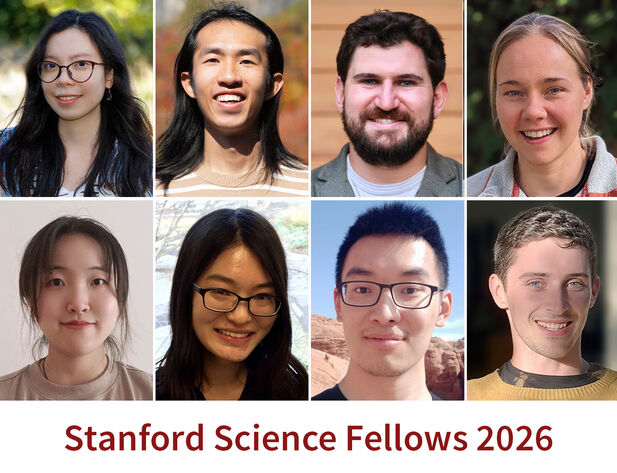
The 2026 Stanford Science Fellows:
Anna Bui studies how fluids behave across different scales from molecular interactions to large flows. At Stanford, she will use machine learning to enable inverse design of biologically inspired functions in ionic materials for energy storage and neuromorphic computing. She will work with Tom Markland, professor of chemistry in H&S and Grant Rotskoff, assistant professor of chemistry in H&S.
Junkai Dong conducts theoretical and numerical analysis of two-dimensional materials. He will work with Trithep Devakul, assistant professor of physics in H&S, to investigate how to engineer novel, correlated topological phases by combining analytic insight with experimentally grounded modeling.
Jonathan Gewirtzman researches how plant and microbial communities shape greenhouse gas fluxes in forest ecosystems. At Stanford, he will study the ecology of tree microbiomes in tropical forests, including their potential to be used as a tool for biological methane removal. His faculty host is Rob Jackson, professor of Earth system science in the Stanford Doerr School of Sustainability.
Emily Geyman conducts research using field observations, remote sensing, and numerical models to measure how landscapes change over time and specifically how they store and release carbon. At Stanford, she will work on developing machine learning approaches to better understand how landscapes respond to climate change and shape Earth’s climate through carbon-cycle feedbacks. She will work with Ching-Yao Lai, assistant professor of geophysics in the Doerr School of Sustainability.
Yuxin Jiang studies the growth, structural dynamics, and optoelectronic properties of perovskite nanowires. At Stanford, she will explore the atomic precision synthesis of functional materials through electron microscopy techniques. Her faculty hosts are Kate Reidy and Andy Mannix, both assistant professors of materials science and engineering in the School of Engineering.
Zeran (Rico) Lin has explored the development and function of beige adipocytes, fat cells that produce heat in response to cold stimuli, offering insights into targeting these cells to treat obesity. At Stanford, he will work with Lauren O’Connell, associate professor of biology in H&S, to explore how organisms evolve and adapt to extreme environments, integrating approaches from molecular biology, evolutionary biology, and ecology.
Ruishi Qi studies strongly correlated electron-hole fluids in van der Waals heterostructures. At Stanford, Qi will continue investigating quantum many-body phenomena in low-dimensional systems, working with faculty host Tony Heinz, professor of applied physics in H&S and of photon science at SLAC National Accelerator Laboratory.
Owen Tuck investigates how immune systems function at the molecular level and evolve to counter new viral threats. At Stanford, he will study how immune interactions generate complexity in the human gut. His faculty host is Ami Bhatt, professor of medicine (hematology) and of genetics in the School of Medicine.
Acknowledgments
Bhatt is also a member of Bio-X, the Cardiovascular Institute, Maternal & Child Health Research Institute, Stanford Cancer Institute, Stanford Medicine Children’s Health Center for IBD and Celiac Disease, and Wu Tsai Neurosciences Institute.
Heinz is also the director of the Edward L. Ginzton Laboratory and a principal investigator of the Stanford Institute for Materials and Energy Sciences and the Stanford PULSE Institute.
Jackson is also the Michelle and Kevin Douglas Provostial Professor as well as a fellow of the Woods Institute for the Environment and the Precourt Institute for Energy.
Lai is also a member of the Institute for Computational and Mathematical Engineering
Mannix is also a member of Bio-X.
Markland is also a member of Bio-X and a principal investigator at the Stanford PULSE Institute.
O’Connell is also a faculty fellow of Sarafan ChEM-H and a member of Bio-X, the Maternal & Child Health Research Institute, and the Wu Tsai Neurosciences Institute.
Rotskoff is also a faculty fellow of Sarafan ChEM-H and a member of Bio-X and the Institute for Computational and Mathematical Engineering.
Simon is also the Joan Reinhart Professor in H&S.
H&S adds 20 new faculty members
Sarah Peluse named Packard Fellow
Robert E. Hall wins Nobel in economics