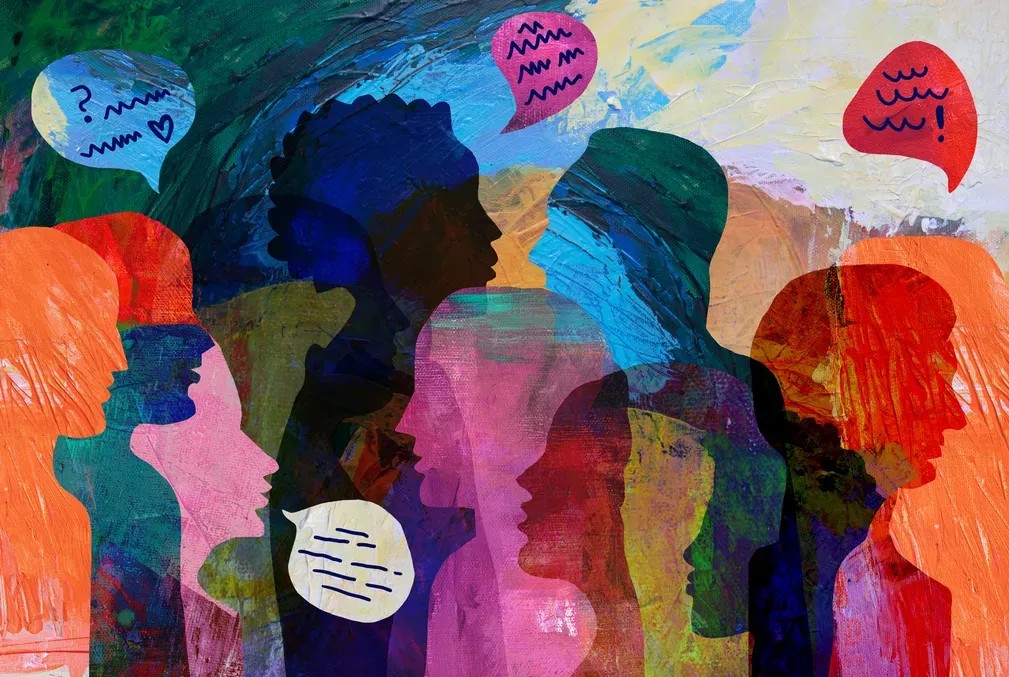
Beloved podcast 'Philosophy Talk' now available for free
Philosophy Talk hosts Ray Briggs (left) and Joshua Landy (far right) talk with guest Julian Jara-Ettinger (center), director of the Computational Social Cognition Lab at Yale University.
The popular show, which originated with support from Stanford, will reach an even wider audience.
“Philosophy should be for everyone.”
That, in short, is how Joshua Landy, the Andrew B. Hammond Professor of French Language, Literature, and Civilization and professor of comparative literature in Stanford’s School of Humanities and Sciences, explains the recent decision to make the podcast he co-hosts, Philosophy Talk, available for free. The show has more than 600 episodes and has aired for more than 20 years as both a nationally syndicated radio program and a podcast.
With his co-host Ray Briggs, a former Stanford philosophy professor who is now at the University of Chicago, Landy has explored heavyweight topics like cancel culture and lighter fare like the social lives of robots, all with a jovial sense of play and curiosity.
“The show has long drawn an audience of serious and amateur philosophers alike,” said Debra Satz, the Vernon R. and Lysbeth Warren Anderson Dean of the School of Humanities and Sciences and an occasional host and guest of Philosophy Talk. “Moving the show from behind a paywall will make its wit, insight, and spirit of inquiry available to a wider audience, and you don’t have to be a philosopher to find the joy in that.”
The philosophies of Aristotle, procrastination, and smell
In conversation, Landy and Briggs fall into a natural rhythm that includes asking each other questions, teeing up the other’s answers and anecdotes, and leaning into one another’s expertise. It’s a rapport born of seven years of recording together. Landy joined the show in 2017 at the invitation of Kenneth Taylor, the late Henry Waldgrave Stuart Professor of Philosophy, who co-founded the show in 2004 with John Perry, professor of philosophy, emeritus, and Ben Manilla, an audio producer. After Taylor’s death in 2019, Landy asked Briggs, a frequent guest, to join as a co-host.
Episodes have focused on everything from philosophers both well known (Aristotle) and less so (Zhuangzi) to gender, how logic works, and the philosophy of smell, a favorite of Landy’s. “We think of the shows as falling under different kinds of umbrellas,” he said. “There are big names, and there are also big questions, like what is love? and schools of thought, like Taoism and Stoicism. There are some topical issues—we've talked about climate, post-truth, and identity—and then these everyday conundrums like pet ethics and procrastination.”
‘Socrates would walk around badgering people’
The show was originally paywalled due to Taylor’s belief that it was the most viable way for Philosophy Talk to support itself. But the co-hosts began to think otherwise and even considered a tradition in philosophy in which the ancients would refuse to charge a fee for their schools. “Socrates would walk around badgering people,” Landy said. “That’s sort of the opposite of charging a fee.”
Not only will future episodes be more widely available—early ideas include something on Dostoevsky and episodes on Jewish philosophy and Islamic philosophy—the archives will be, too. This means fans can sniff out that smell episode and enjoy interviews with the likes of the late poet Louise Glück, Michael Schur (creator of The Good Place), and others. And while the show is no longer taped live, the duo is planning a live event this spring with Matthew D. Morrison, associate professor of African and African American Studies in H&S and author of the recent book Blacksound: Making Race and Popular Music in the United States.
Philosophy Talk is produced by KALW 91.7 FM on behalf of Stanford University and is part of the Public Humanities Initiative.
Satz is also the Marta Sutton Weeks Professor of Ethics in Society and professor of philosophy in H&S.

H&S adds 20 new faculty members
Sarah Peluse named Packard Fellow
Robert E. Hall wins Nobel in economics