Inside the new home of the Department of African and African American Studies
The remodel of Building 80 looks toward the future while being rooted in the past.
The Department of African and African American Studies (DAAAS) in the School of Humanities and Sciences will officially welcome the campus community to its new home in Building 80 on May 1. An event in Memorial Church featuring speakers reflecting on the legacy and future of the department will precede a ribbon cutting and open house celebration. RSVPs are encouraged.
On Stanford’s Main Quad, the building welcomes students and faculty to learn and spend time with one another with its central element—an airy, auditorium-style space intended for events, presentations, and everyday use. Art and furniture by Black artists and designers from Africa and the African diaspora (including those in the United States) define the sense of place and add meaningful style to every room. The new space is the result of decades of work including the establishment of the department in 2024.
“It’s a remarkable space—for both its beauty and the power of the history that has led to this point,” said Debra Satz, the Vernon R. and Lysbeth Warren Anderson Dean of the School of Humanities and Sciences. “I look forward to witnessing how it inspires our students in their studies, sparks great conversations, and serves to convene scholars and students who will deepen our understanding of both Africa and the experiences of African Americans.”
A space for lingering and serendipity
The interior was designed by Leddy Maytum Stacy Architects (the same firm behind the nearby Martin Luther King, Jr. Research and Education Institute), in consultation with DAAAS faculty and staff. Prompted by the architects, Ato Quayson, chair of the department, provided two guiding principles for the space: lingering and serendipity. The idea is that students should feel welcome to spend time hanging out in the building. This in turn would foster serendipity—those connections, both academic and personal, that only happen when one is in the right place at the right time.
“When you think about it, some of our best friendships have started serendipitously,” said Quayson, professor of African and African American studies and of English. “But you cannot have serendipitous encounters without lingering.” Toward that end, the building features a showstopping entry space, designed with stadium seating, where scholars can present and where students can relax and study.
Across two floors, there are ten faculty offices, four offices for lecturers, and an administrative suite that will allow faculty and staff to talk with each other seamlessly. Upstairs, there are study rooms and spaces for graduate students. The two floors share a feature that is relatively rare for a historic Stanford building: an elevator.
Craft, history, and culture
Connections to the department’s history abound. Those entering the building will receive a reminder of the long journey that resulted in its existence: Two photographs from the 1968 demonstrations that catalyzed the establishment of the interdisciplinary African and African American Studies Program, the precursor to the department. In one, students are marching. Another shows the famous “Take Back the Mic” protest, in which Black students and community members from East Palo Alto took the stage during an all-White (and male) panel discussion on racism. It’s all meant to symbolize the importance of the past in shaping the present and the future, a message that’s echoed in a motif found throughout the building, that of a Sankofa bird. From the Akan people in Ghana, the bird is depicted flying forward with its head turned back to retrieve an egg.
The artwork throughout the building was acquired through gifts from donors, and it was curated by Katie Dieter, the department’s director of advanced studies and community-engaged learning, in consultation with Quayson and Sandra Kiapi, the department’s director of finance and operations. Notable pieces include tables designed by Jomo Tariku, whose work was featured in the Black Panther films. There are fabrics by the American artist Nick Cave, bronze pieces by the Ghanaian sculptor Aziz Abdu, and a commissioned painting by Fahamu Pècou. (In the last of these, eagle-eyed viewers will spot The Hills of Hebron, a novel by Sylvia Wynter, the first female faculty director of the program.)
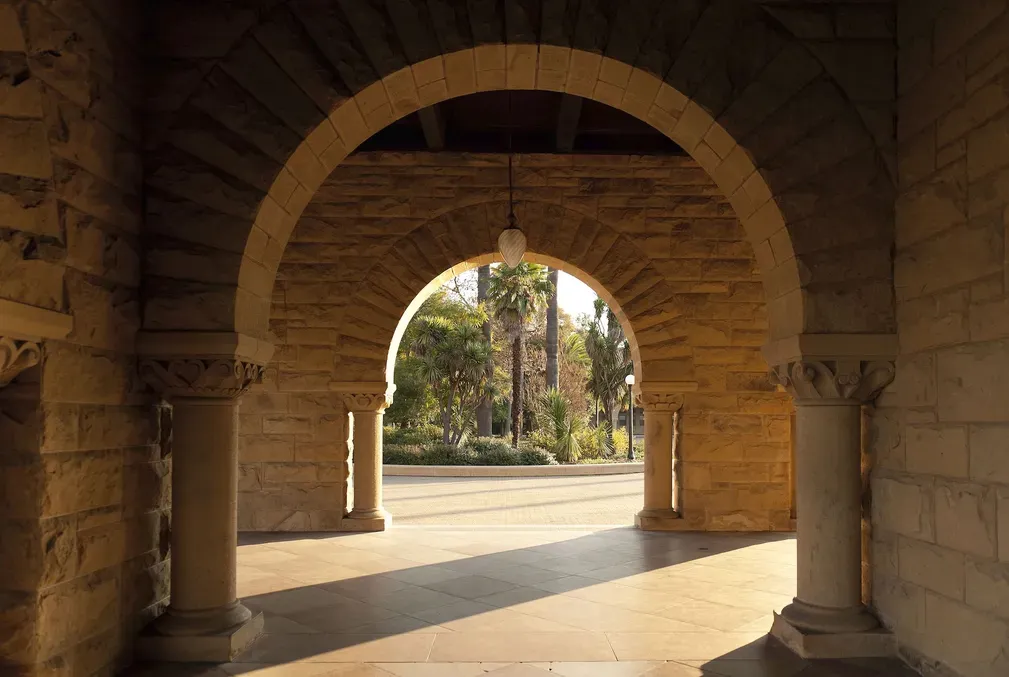
The department is a stone’s throw from Memorial Church, a location that draws visitors from throughout the world. “It’s an iconic Stanford image,” Dieter said. “I was thinking about this the other day as I was looking out the window, and I was seeing students, faculty, and staff passing by and also tourists taking pictures. I thought how beautiful it is that we've been placed in this building that represents the nature of Stanford, a place that signals the importance of this department and the legacy that it upholds.”


H&S adds 20 new faculty members

New undergraduate minor launches in civic thought and practice