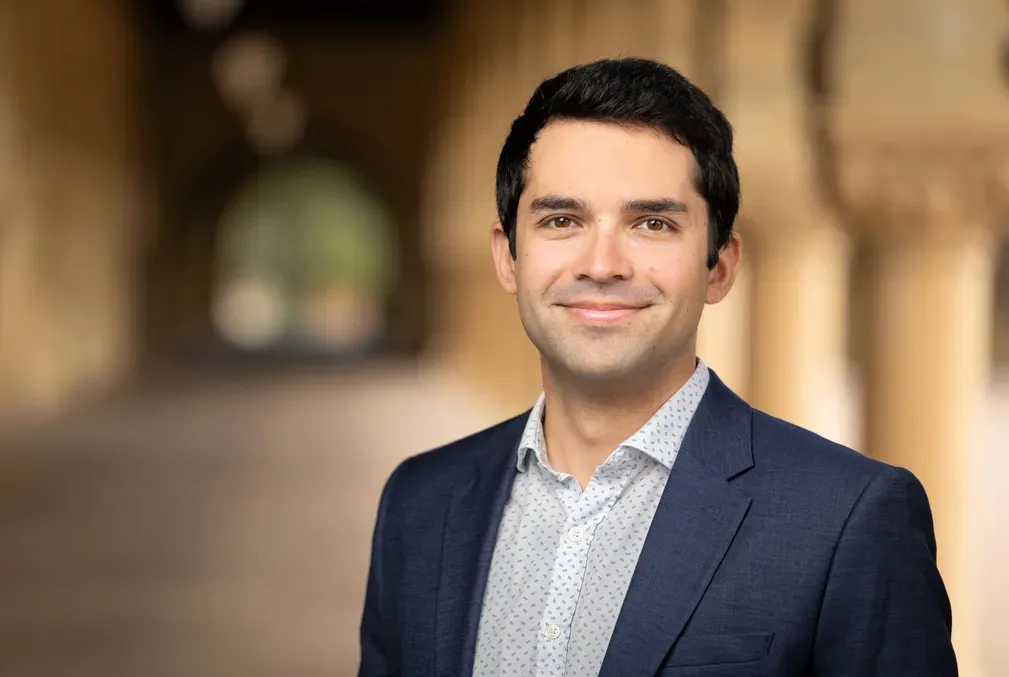
New book takes on the dominance of Silicon Valley billionaires
In What Tech Calls Governing, Stanford humanities professor Adrian Daub delivers a blistering critique of America’s tech elites and their growing political power.
The leaders of Silicon Valley have long touted their technology as transformational, and their products—including smartphones, search engines, and online shopping—have had an undeniable impact on society.
This desire to transform has developed into a much larger goal than selling products, according to Stanford professor Adrian Daub. He makes this case in his new book, What Tech Calls Governing (Stanford University Press).
“In the last five years, companies have stopped promising us the world and are instead content to dominate it,” writes Daub, the J.E. Wallace Sterling Professor in the Humanities in Stanford’s School of Humanities and Sciences (H&S). “Their power of persuasion has run out; raw power remains.”
With his new work, Daub builds on the arguments of his 2020 book, What Tech Calls Thinking , which took the shine off of Silicon Valley’s myth of newness. Now Daub, who is also the Barbara D. Finberg Director of the Michelle R. Clayman Institute for Gender Research in H&S, contends that this drive for dominance is linked to the fragile masculinity of some of tech’s biggest names. He traces a throughline in the way these tech elites try to wield power from within their families and personal relationships to public spaces including gyms, universities, social media, and courtrooms.
In the following excerpt, Daub describes the ways that the technology leaders responded to the pandemic and how that foreshadowed the current U.S. administration.
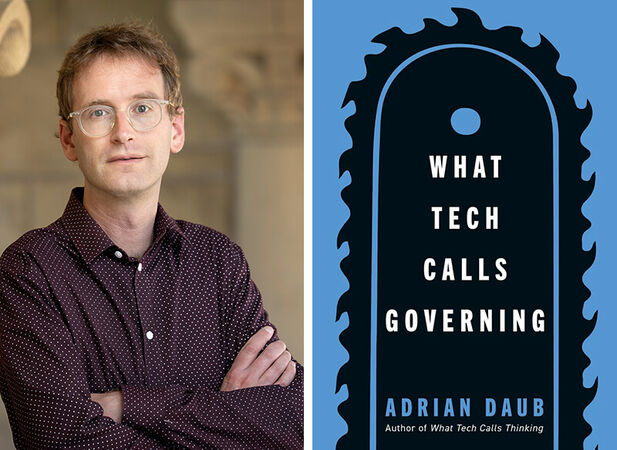
Excerpted from What Tech Calls Governing by Adrian Daub. Used with permission of the publisher, Stanford University Press, English translation. Copyright 2026, by the Board of Trustees of the Leland Stanford Junior University. All Rights Reserved.
When COVID forced the United States into lockdown in March 2020, the tech companies reacted with a slew of proposed solutions. But notably, they were the kinds of solutions they proposed whenever anything needed solving. Their proposed fix was to collect people’s data, or to get them to download unnecessary apps. The reaction of Silicon Valley’s superrich coupled activism with cynical self-enrichment, and they used the pandemic to criticize government, while engaging in as little self-reflection as humanly possible. The sector approached the pandemic with its characteristic “solutionism”—that tendency to misunderstand complex social problems as a series of easily solvable technical problems. Everything was half self-promotion, half misunderstanding.
On Twitter/X, Musk’s disciples begged their idol to “invent” a miracle cure for the virus (preferably in collaboration with Bill Gates). Musk seemed flattered by the tributes offered to him. At the same time, he was desperate to swim against the current, which tends to make leadership difficult in times of crisis. And so it happened that Musk, on the one hand, promised quick solutions and, on the other hand, tweeted like a second-rate blogger, that “the coronavirus panic is dumb.”
Peter Thiel’s big data play Palantir suddenly touted its own software as a means for contact tracing. The investor Shervin Pishevar made headlines for organizing a fleet of two hundred 3D printers that were supposed to produce “ventilators and masks.” The billionaire Tom Siebel gathered a group of tech luminaries around him to deploy “money and AI” against the virus. Elon Musk promised to procure ventilators for California hospitals. Tim Draper boasted that, “while old methods were flailing on creating a cure, it was the company Verge Genomics, a Computational Biochemistry company that determined which FDA approved drug would be the best treatment for Covid-19.”
If you don’t quite remember any of this, it’s because solutionism hit some firm limits at the beginning of the pandemic. Much of what Silicon Valley promised was, at best, opportunism, a pitch, and a publicity stunt. At worst: incompetence. The Valley primarily perceived the unprecedented crisis as an opportunity to once again beat the drum for itself and implicitly belittle the state and its capabilities. Verge Genomics, a biotech start-up funded by Y Combinator, did indeed have a drug for amyotrophic lateral sclerosis in its pipeline—a possible cure for the new virus. As fate would have it, however, the key did not quite fit the lock. The 3D-printed masks apparently never materialized. Musk really did send material to California hospitals—what arrived at the hospitals, however, were respiratory therapy devices used to treat sleep apnea, but crucially not COVID-19.
The medical breakthroughs that more or less ended the pandemic came from the FDA and the pharmaceutical industry, not from Y Combinator. In the end, it was the experts from international organizations, and various levels of the government who enabled a return to normal.
But while they were feigning responsibility, even statesmanship, the elites of Silicon Valley also gave in to their opposite impulse: to isolate themselves, to buy their way out of collective fate. While Peter Thiel tried to convince governments to adopt Palantir’s contact tracing technology, many in Silicon Valley’s executive suites were more interested in his free-trade islands, the “seasteading” project. Ultimately, no billionaire actually moved to sea, but many fled to bunkers or remote estates, particularly in New Zealand.
In general the pandemic intensified the tendency among CEOs to offer grand pronouncements about the state of the world—whether they dismissed the pandemic Trump-style as a “hoax,” understood it as a doomsday scenario, or (as in most cases) both at once. Marc Andreessen used the pandemic as an opportunity for a general reckoning with “the West” and its “institutions.” “Every Western institution was unprepared for the coronavirus pandemic, despite many prior warnings. This monumental failure of institutional effectiveness will reverberate for the rest of the decade,” he wrote in April 2020. On the surface, Andreessen’s essay was a fundamental critique, but it seemed to exempt Silicon Valley, or at least people like himself, from this criticism. In fact, the crisis, at least according to those in Silicon Valley, only served to confirm Silicon Valley’s own self-image.
Tim Draper once again predicted the age of blockchain—once the lockdowns were lifted, he wrote on Twitter, the dollar would effectively have already been replaced by Bitcoin. For many entrepreneurs in the Bay Area, the intervention of the city and state was a shock. But above all, it came as a shock to those among them who were no longer actively running businesses but were instead cosplayers pretending to be entrepreneurs. CEOs who were already retired, former founders who spent their days playing tennis and hanging out on Twitter.
In 2020, this was true for most of the prominent CEOs or VCs, whether it was Bezos or Draper, Andreessen or Sacks, or Thiel. Even Musk, despite his restless energy, was a super-senior pretending to be a freshman. They no longer had to go to an office with strangers every morning, and yet it was extremely important to them that others should please go to the office to hang out with strangers every morning. They reacted with incomprehension to the fact that the government was quite generous in enabling work-from-home arrangements. In their libertarian moral calculus, they had bought their way out of worry and fear of death. The fact that (some) others should now no longer be plagued by worry and fear of death, although they felt was morally those people’s lot, seemed to them an injustice. That was their fundamental experience of COVID: They perceived being the same as others as persecution, as an upending of the moral order of the world.
After some initial turbulence, the pandemic led to a veritable boom for the tech industry. The region around the San Francisco Bay had earlier and more effective lockdowns than other parts of the US. This kept the death toll very low, but it continues to affect the area. In particular, the superrich in this region seem never to have gotten over the lockdowns. They felt as powerless as the rest of us, but they also felt disempowered in more specific ways, which has affected their understanding of power in general. And so the lockdowns in Northern California are now shaping the reality of life in far-off countries. The fixation on regulation is nothing new in Silicon Valley. But the relationship with the government was severely affected by COVID.
The attempts by Silicon Valley CEOs to seize control of the reins of state intensified around that time. Moreover, this historic moment influenced what they wanted to control in the first place. They understood the government only in terms of what they could see of it, what affected them in their entrepreneurial activities or their daily lives, or during lockdowns: the existence or absence of regulation, employee protection, and a sense of security.
After all, many a CEO experienced COVID as a humiliation at the hands of their own workforce. Musk was obsessed with the “stupidity” of the COVID measures because they affected his Tesla factory in Fremont, across the Bay from Palo Alto. In spring 2020, Musk waged a bitter battle with Californian regulators, including Governor Gavin Newsom, because he wanted to keep his factory running. “Tesla is restarting production against Alameda County rules,” Musk announced via tweet on May 11, 2020. “I will be on the line with everyone else. If anyone is arrested, I ask that it only be me.”
The tweet shows how strongly these weeks in the spring of 2020 shaped the politics of the following years: the CEO is supposedly “on the assembly line” and offers himself as a sacrificial lamb for his workforce, when in fact he’s making them risk exposure to a dangerous virus. The CEO plays the populist, but actually disregards the will of the people, putting ordinary workers in great danger. And he casts those who try to prevent infections and advocate for the interests of his employees as the villains. Of course, Musk was never “on the line”; he just tweeted that he was. In other words: Musk’s revolt against California regulators in 2020 is structurally indistinguishable from how Donald Trump governs in 2026.
Acknowledgments
Daub is also a professor of German studies and of comparative literature in the Division of Literatures, Cultures, and Languages in H&S.
What Tech Calls Governing was originally published in German in March 2026 under the title Was das Valley herrschen nennt. Copyright Suhrkamp Verlag GmbH Berlin.
Media contact:
Sara Zaske, School of Humanities and Sciences, 510-872-0340, szaske [at] stanford [dot] edu (szaske[at]stanford[dot]edu)
Sarah Peluse named Packard Fellow
Robert E. Hall wins Nobel in economics
New undergraduate minor launches in civic thought and practice