Researchers observe first real-time quantum jump in sound
In an experiment, Stanford physicists demonstrated that tiny units of sound can suddenly change energy states, making a quantum jump. This is a long-anticipated breakthrough with the potential to advance a range of technologies.
In brief:
- Stanford scientists have confirmed the long-predicted ability of quantum units of sound, or “phonons,” to suddenly change energy levels.
- The team created a device that takes hundreds of measurements within two milliseconds to pinpoint the moment of a quantum jump.
- The advance has implications for quantum computing and sensing as well as improving everyday technologies, such as smartphones.
A Stanford team has documented the first direct observation of quantum jumps of sound in a mechanical resonator, completing an arc of scientific exploration that started over a hundred years ago.
Quantum jumps—sudden transitions from one energy state to another—have been theorized since the early 1900s. Scientists first demonstrated these jumps in trapped ions in 1986 and later in photons, the fundamental particles of light, in 2007. Observing quantum jumps of sound had remained elusive, but a team led by Stanford physicist Amir Safavi-Naeini has recorded these phenomena, publishing the findings in the journal Science.
“What this study shows will allow us to move forward with developing new quantum technologies with sound,” said Safavi-Naeini, associate professor of applied physics in the Stanford School of Humanities and Sciences. “We have seen that vibrating objects can exhibit quantum behavior, which is the prerequisite for many of the operations needed by quantum computing and sensing.”
While a quantum unit of light—its smallest possible discrete piece—is a singular photon, a quantum unit of sound, or “phonon,” represents the coordinated movement of a large group of atoms.
To the human senses, vibrating motion from sound, like that seen in a struck bell, appears to decline gradually rather than make an abrupt jump to stillness. At the quantum level, however, a resonator’s vibrational energy changes in discrete steps, or jumps, similar to the quantum behavior of ions and photons. Earlier experiments had found evidence of these jumps, but this study is the first to demonstrate individual phonons making quantum jumps in real time.
Size and timing
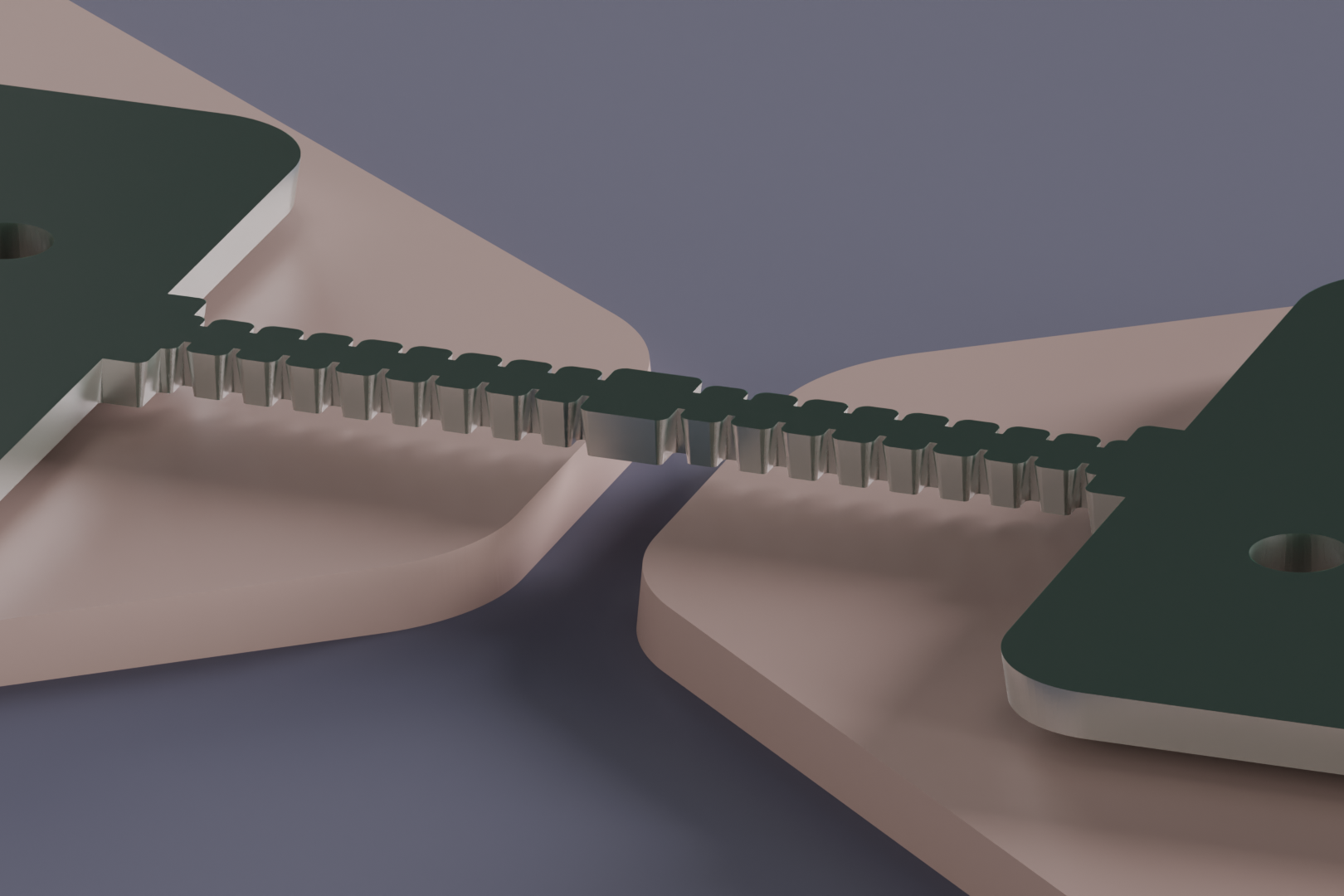
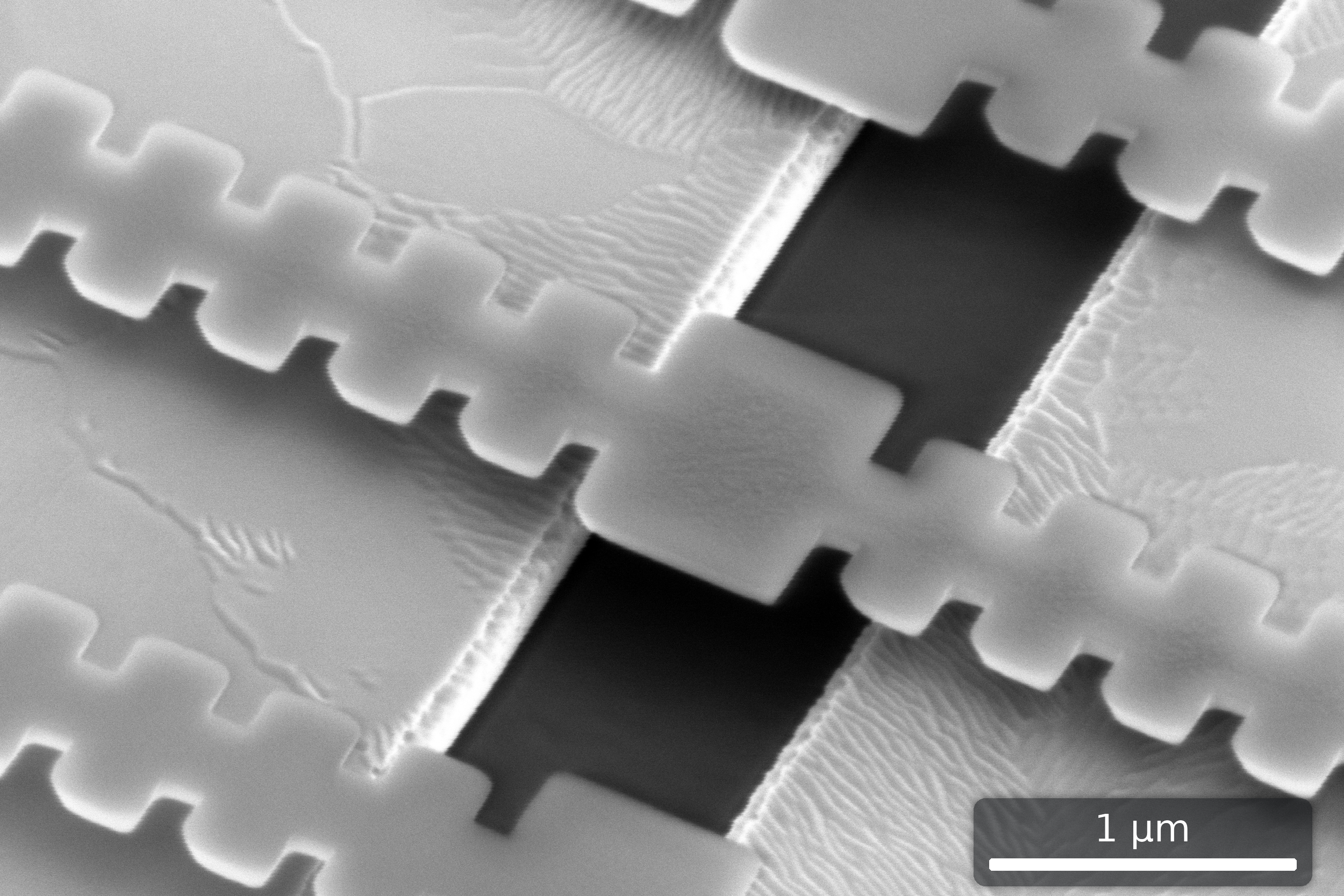
The mechanical resonator was fabricated using chipmaking techniques. It is so small that many resonators could be packed onto a chip to perform complex functions.
The length of time the resonator can “ring” is what made this breakthrough possible. Working sort of like a microscopic tuning fork, the resonator can vibrate for two milliseconds. For comparison, if the same capability were found in a regular-sized tuning fork, it would ring for several hours.
The long resonation or “ringdown time” of the resonator allowed for hundreds of readings to be taken to determine the moment the vibration was no longer present and the sound jumped—when it moved from an energy state of 1 to 0.


This mechanical resonator, depicted in an illustration (left) and in an image taken by a scanning electron microscope (right), allowed researchers to detect quantum jumps of sound. Images courtesy of Erik Szakiel.
Sound control
To conduct this experiment, the researchers had to overcome an ongoing challenge in quantum engineering: how to get a signal out of a quantum system without disturbing its fragile state.
Takuma Makihara and Erik Szakiel, the co-first authors on the study, developed a way to pair the microscopic mechanical resonator with a superconducting qubit, an electrical circuit that can store quantum information and serve as a detector.
“We had to continually develop new processes to make this extremely long-lived, vibrating object and then integrate it with the qubit, which is our little electrical detector—without ruining either subsystem,” said Makihara, a recent Stanford doctoral graduate.
The qubit can read out what is happening in the mechanical resonator, essentially checking over and over during the two milliseconds of vibration if the phonon inside is at an energy level of 1 or at 0. This is how the researchers can record the moment a quantum jump occurs.
Developing a sound platform
This study represents a foundational first step, but the ability to detect quantum jumps of sound could lead to a number of advances.
It could help solve the error correction problem in quantum computing, for instance. While quantum computing holds great potential for handling some complex calculations beyond the capacity of traditional computers, fragile quantum states can cause errors before a calculation is finished. In many quantum computing architectures, a quantum jump represents an error, but identifying when those occur has been difficult. So the ability to detect quantum jumps in sound marks an important step toward error correction.
Because of its small size and high sensitivity, the combination of mechanical resonator and qubit could also be used for extremely precise sensing. For example, Safavi-Naeini’s team, in collaboration with physicist Michael Roukes’ team at Caltech, is already pursuing use of this platform to detect and identify proteins within cells.
Everyday technologies could benefit as well. Sound is integral to smartphones and many other devices, and this advance could be a step toward the next generation of these items, said Szakiel, a current doctoral student in Safavi-Naeini’s lab.
“This shows we can have incredibly fine-tuned control of sound, which might mean that devices that use sound as a fundamental technology can get much better,” he said.
Acknowledgments
Safavi-Naeini is also a member of Stanford Q-FARM and Bio-X.
Additional Stanford co-authors include David Schuster, the Joan Reinhart Professor and professor of applied physics in H&S; Shannon Harvey, a scientist with SLAC National Accelerator Laboratory; Mihir Pendharkar, physical research scientist at the Edward L. Ginzton Laboratory; former applied physics doctoral scholar Rachel Gruenke-Freudenstein; and Oliver Hitchcock, Matthew Maksymowych, and Kaveh Pezeshki, doctoral scholars in applied physics.
This research received support from Amazon Web Services Inc., the Air Force Office of Scientific Research, the Office of Naval Research, the National Science Foundation, the Natural Sciences and Engineering Research Council of Canada, and the U.S. Department of Defense.
Safavi-Naeini and Schuster are both Amazon Scholars.
Media contact:
Sara Zaske, School of Humanities and Sciences, 510-872-0340, szaske [at] stanford [dot] edu (szaske[at]stanford[dot]edu)


H&S adds 20 new faculty members

Sarah Peluse named Packard Fellow