Jonathan Luk tackles the mathematics of black holes
The Stanford mathematician’s work opens up new possibilities—and questions—about Einstein’s theory of general relativity and, ultimately, the nature of the universe.
Albert Einstein’s theory of general relativity has a math problem, several problems actually. They have to do with black holes and are extremely complex and difficult to solve—just the kind of problems that have always fascinated Jonathan Luk.
This fascination led the Stanford mathematician to a long collaboration with Princeton’s Mihalis Dafermos that disproved the “strong cosmic censorship conjecture,” the hypothesis that sought to save general relativity from the loss of determinism. What Luk and Dafermos showed is that determinism, or the idea that the future is always predicated by past data, does not always hold true within certain types of black holes.
Their achievement was recently recognized with a 2026 Bôcher Memorial Prize, the American Mathematical Society’s top prize for mathematical analysis. Their work also pokes a hole in determinism, leaving open the possibility of unpredictable futures—at least deep within some black holes. This has troubling implications, but for Luk, it just means there is more work to be done.
“I think the important thing is to first understand what happens inside black holes; then we can try to understand what it means,” said Luk, professor of mathematics in Stanford’s School of Humanities and Sciences.
The search for solutions
When Einstein wrote the theory of general relativity in 1915, he included a set of equations describing how the gravity of large objects curves space-time—and physicists and mathematicians have been trying to find solutions to those equations ever since.
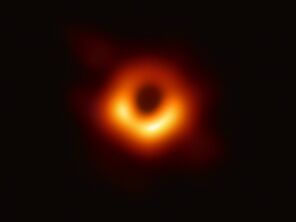
The equations suggested the existence of black holes, areas where gravity becomes so strong not even light can escape. Evidence of black holes was gathered in the ensuing 100 years, but it wasn’t until 2019 that astrophysicists captured the image of one.
Yet the search for solutions to Einstein’s equations also found some problems: namely that inside some rotating black holes, there is a location, called the Cauchy horizon, after which determinism breaks down. In other words, beyond that horizon the past doesn’t predict the future —an idea that challenges our understanding of the universe.
To save determinism, the physicist Roger Penrose proposed the strong cosmic censorship conjecture in 1979. He argued that the Cauchy horizon was unstable and any gravitational wave that made it past would just cause a crushing singularity, a point at which matter is condensed into an infinite density. This singularity would end space-time and protect the theory from producing unpredictable futures.
Through their work, Luk and Dafermos found that there is no crushing singularity, as Penrose proposed, even when space-time is “perturbed” or distorted by gravitational waves. That means that space-time could still be unpredictable beyond the Cauchy horizon within a black hole. The mathematicians essentially found a new aspect of Einstein’s equations.
“Luk and Dafermos really achieved something that was very unexpected,” said Rafe Mazzeo, the Cassius Lamb Kirk Professor of the Natural Sciences and professor of mathematics in H&S. “In terms of the mathematical understanding of relativity, it’s really a huge advance.”
The intersection of physics and mathematics
This discovery, like a lot of things in mathematics or science, took many years. Luk describes solving complex problems like this as a process that has many obstacles.
“In mathematics, I think you are always stuck,” he said.
That frustration doesn’t deter Luk. In fact, the more difficult a problem is, the more fascinating he finds it. This has been true ever since he faced his first challenging, nonstandard math problem as a fourth grader.
For most problems, it’s less that you suddenly have an idea that allows you to solve it. It is more that you realize that all the pieces are there, and it is, in fact, already solved.
Luk started as a physics major at the University of California, San Diego but was soon drawn to mathematics. During his studies, one of his mathematics professors, Lei Ni, suggested that they try reading “a difficult text” together. That turned out to be Luk’s first exposure to general relativity.
“In some sense, I still think of myself as somewhat in between physics and math,” Luk said. “It is the combination of solving problems that have something to do with nature but using methods to say something definitive that really attracts me.”
For his doctorate, Luk studied under Princeton mathematician Igor Rodnianski. After Luk solved his first difficult problem his second year in graduate school, Rodnianski invited him to explain it. When Luk arrived at his mentor’s office, he found that Dafermos, then a mathematics faculty member at the University of Cambridge, was also in the room. Luk remembers talking for three hours straight.
Not long after, in 2011, Dafermos invited Luk to Cambridge to talk to his students about another problem related to impulsive gravitational waves. A couple years later, they started working together on the interiors of black holes, and some of the same methods Luk had used to solve the gravitational wave problem proved useful in that project. Dafermos and Luk have since published a 322-page paper on what they discovered about black holes.
While Luk recalls writing some thoughts down late at night, he said there was no one flash of inspiration that led to the discovery.
“For most problems, it’s less that you suddenly have an idea that allows you to solve it,” he said. “It is more that you realize that all the pieces are there, and it is, in fact, already solved.”
As a Stanford professor, Luk advises his mathematics students to approach complex problems by first working on the simplest piece that they cannot solve. Then, after they tackle that, they can move on to the more challenging parts.
For his own work, Luk has moved from the inside of black holes to the outside. While there is still a lot to learn about these phenomena, Luk thinks a key piece is understanding how the region outside black holes becomes stationary. The incredible gravity of black holes causes many things to fall inside, but at a certain point the objects outside black holes remain in place—and understanding how that happens may help illuminate what happens inside black holes too.
Media contact: Sara Zaske, School of Humanities and Sciences, 510-872-0340, szaske [at] stanford [dot] edu (szaske[at]stanford[dot]edu)

New undergraduate minor launches in civic thought and practice

Adrien Bilal selected for Time100 Next

Peter M. Ray, biologist with a passion for winemaking, has died at 94