Initiative aims to help cities address migration
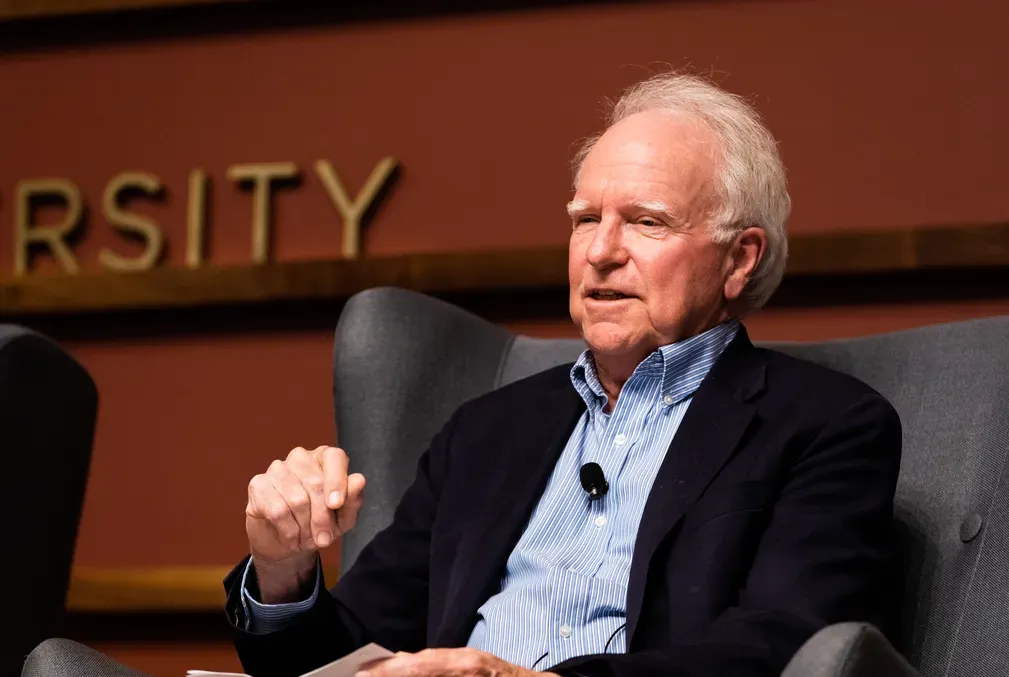
Tomás Jimenéz, faculty director of Stanford’s Institute for Just Societies, speaks at the launch of the institute’s Flourishing Cities Initiative.
The Institute for Advancing Just Societies’ Flourishing Cities Initiative involves faculty from all 7 Stanford schools and politicians of both parties.
Two politicians—one Republican, one Democrat—share a hearty laugh. They calmly present evidence-backed ideas and thought-starters. Surely, they’re discussing something everyone can agree on. But no, the topic at hand is one of today’s biggest cultural and political lightning rods: immigration.
The conversation is courtesy of the Flourishing Cities Initiative, and the politicians are discussing the question of how cities can make migration work for everyone. Answering that question is the primary mission of the initiative, led by Stanford’s Institute for Advancing Just Societies.
We spoke with Tomás R. Jiménez, faculty director of the institute and professor of sociology in the School of Humanities and Sciences, about the focus on the role of local government in the movement of people and why now is the right time for the initiative.
This Q&A has been edited for clarity and length.
Question: What was the impetus behind the initiative?
Answer: In 1932, Justice Louis Brandeis said that states were the “laboratories of democracies.” And my own observation is that cities are the petri dishes of those labs. So when we looked for the opportunity to produce and amplify research that could have a meaningful impact and scale up, we thought it made sense to start with cities.
Question: How long has this been percolating in your brain?
Answer: Because I'm a scholar of immigration, a very long time. But as an institute, I would say a year and a half. We spent probably three-quarters of last year doing research among our colleagues and the outside stakeholders to identify a first initiative, which we launched in November.
Question: Who are the outside stakeholders?
Answer: One collaborator in this effort is an organization called Welcoming America. It has a welcoming standard—various criteria for cities to be welcoming both to newcomers and to long-established populations. The overall aim is for those two populations to figure out how to thrive together, and that really aligns with the mission of the institute. In May, we're bringing practitioners and faculty together to focus on what we can learn from each other with the aim of forging a research and practice ecosystem.
We also have an ambitious cultural project with Zócalo Public Square. It is a Los Angeles-based organization with a 20-plus-year track record of doing programming all over the world that thoughtfully answers big questions. The question we're answering with them is: What can become of us in the world of migration? We've commissioned works of art and will use presentations by the artists to catalyze conversations with thought leaders and practitioners in four places in the United States, culminating in a public event here at Stanford on March 11.
We also have access to an international network of mayors that has agreed to be a disseminator of any insights that we produce. We hope to expand it and include even some specific cities.
“How Do We Dance with Legacy?” Event
Wed., March 11, 2026, at 5:30 p.m. at Bing Concert Hall
Join the Institute for Advancing Just Societies and Zócalo Square to envision new perspectives on migration, America’s changing communities, and how people come together across differences.
Question: Your current project includes artists, and you had a singer at the initiative’s launch. Why is it important to have artists involved in this work?
Answer: Our engagement with the arts is central to the ethos of the institute. The world is crying for solutions to the problems that stem from the movement of people, and these need to be rooted in rigorous research and well thought out. But to unlock the creativity and inspire the hope required to get there, you need something to shake you out of reality as we think it's constituted, and the arts do that.
Question: You’re not just studying this issue but trying to effect real change in the world. Why is that important to you?
Answer: It's important to me personally because of my background. On my mom's side, I'm the great-grandson of four Italian immigrants. On my dad's side, I'm the son of a formerly undocumented Mexican immigrant. My dad was undocumented for most of his childhood and was able to legalize in the ’50s and became a citizen in the ’60s. So the stories about immigration from both sides of my family and how various policies directly and indirectly affected their lives had a profound effect on the kind of things I studied and care about. So it's personal.
But more than being personal, it’s about addressing challenges and harnessing the opportunities that come with a feature of human life that has been present since the beginning of civilization—people move. And there’s a richness and a dynamism that comes from that movement. That movement can also challenge us in all kinds of ways. So if we can use the incredible research firepower we have at Stanford to address the challenges and figure out how to harness the opportunities, we will have accomplished something really important.
Learn more about the Flourishing Cities Initiative.
Question: It’s clearly important to your colleagues—you have contributions from all seven schools at Stanford, even medicine and engineering—and to you as a scholar.
Answer: I've just seen insights that have enormous potential to have real-world impact get locked in the academy. Some of that is just because of the tradition, especially in the social sciences, of being more inwardly focused. As I've gone along in my career, my own desire to unlock those insights parallels a larger desire among my faculty colleagues to address the kinds of problems in the world that they care about and to use the insights that research generates to help make that impact. The institute exists to bring this community together to do that.
Acknowledgments
Jiménez is also the Joan B. Ford Professor in the School of Humanities and Sciences and the Robert and Ruth Halperin University Fellow in Undergraduate Education.
Robert E. Hall wins Nobel in economics

New undergraduate minor launches in civic thought and practice
Adrien Bilal selected for Time100 Next