New book explores the tension that can exist between people of different identities—and how to overcome it
In Churn, social psychologist Claude Steele examines the challenge of diversity and offers a new approach to making it work.
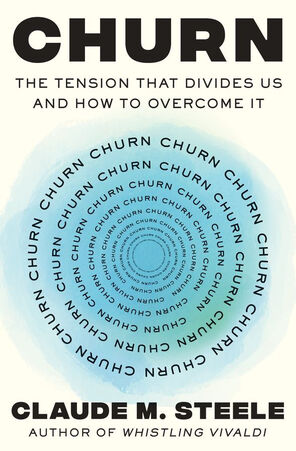
With his new book, Churn: The Tension That Divides Us and How to Overcome It (Liveright), Stanford social psychologist Claude Steele introduces the idea of “churn,” the discomforting tension that can exist between people of different identities in important situations.
This tension can intrude at school, work, traffic stops, or elsewhere—any high-stakes setting in which groups are diverse. In those scenarios, churn can be a mental and physical distraction, undermining our performance and relationships, not to mention our trust in a situation’s fairness. In these settings, we might also fear being seen through the lens of negative stereotypes about our identities, including our race, gender, age, sexual orientation, religion, and more.
Given this stress, many of us might succumb to the pressure to avoid these scenarios altogether. But Steele argues that churn has an antidote: trust. When individuals build trust, it reduces the threat of these stereotypes, allowing diversity to be a more successful experience for all. Churn focuses on how to build that trust.
We spoke with Steele, the Lucie Stern Professor in the Social Sciences, Emeritus, in Stanford’s School of Humanities and Sciences, about how the book came together.
This Q&A has been edited for clarity and length.
Question: How did you settle on the word churn?
Answer: It seemed to capture the stress of being in an important setting—a classroom, a workplace, etc.—and because it is diverse, struggling with what we can say or do, or how our identity will affect our reception there. Most approaches to diversity stress the need to reduce intergroup prejudice, something I heartedly endorse. But churn is different. It affects the prejudiced and nonprejudiced alike, arising, as it does, not from prejudice per se but from the identity threat that all parties in a diverse setting can feel. Not in less important settings, like a subway or an arena crowd, but in settings that are important to us. That’s when churn can take over.
Question: What are some ways to overcome churn?
Answer: With the aim of seeing human difference as different manifestations of a shared humanity, I suggest viewing difference as an opportunity to learn about the culture and conditions of life that different identities experience in society. Being interested in others also tends to elicit their trust—reducing their churn, as well as one’s own.
Question: What else?
Answer: While color blindness is essential in many aspects of life—the law, policing, health care, etc.—we shouldn’t let it blind us to the different realities that people can face in society based on their identity. If I assert color blindness, it can leave people wondering if I really appreciate the identity-based realities they face. And that wondering can make it more difficult for them to trust me.
Book Event Livestream
Wed., March 11, at 6 p.m.
Steele will be in conversation about the book with the Commonwealth Club World Affairs of California.
Question: That connects to something else you talk about in the book, which is the importance of moving from an observer’s perspective to an actor’s perspective.
Answer: To illustrate these perspectives, let’s take a fictional example of trying to understand why your research collaborator is often late to meetings. As an observer of your collaborator, it’s the collaborator who is center stage in your mind. So in explaining the tardiness, things about the collaborator come to mind: they’re disorganized, they don’t care about your shared research, etc. But if you are the late collaborator, the actor in this situation, you don’t really see yourself. You’re looking at the world you’re contending with; you see your life circumstances. So in explaining your tardiness, you point to those circumstances: the class you’re teaching that ends at the same time lab begins or your continued struggle to find reliable childcare.
In this way, the two perspectives lead to completely different explanations of the same tardiness—and completely different remedies for it.
Thus, when trying to build trust between identity groups in a setting like a school or workplace, it is good to be more than just observers of each other. As much as possible, it is worth trying to take each other’s “actor”’ perspective to better see the realities being contended with, including those tied to identity.
The mere effort to do this can engender trust and lower churn. It gives the groups some assurance that their full humanity is appreciated. But it also creates a diverse setting in which people have deeper understandings of each other with which to address the challenges they face. The book gives several examples of such efforts at both universities and corporations.
Question: What is your chief aspiration for a book like Churn?
Answer: As handwashing was used to gain traction against hospital-acquired infections, Churn is in search of traction against the tension that can exist between races, ethnicities, genders, social classes, generations, sexual orientations, immigrant statuses, and more as we live and work together in the settings of our lives.
Churn tries to do for this tension in American life what handwashing did for hospital-acquired infections—give us ways forward that everyone can use.

H&S adds 20 new faculty members

Sarah Peluse named Packard Fellow

Robert E. Hall wins Nobel in economics