Aracelis Girmay wins PEN America poetry prize
The professor of English’s Green of All Heads is described as “a nuanced meditation on loss and motherhood.”
“And the winner of this year’s PEN/Voelcker Award for Poetry Collection is …”
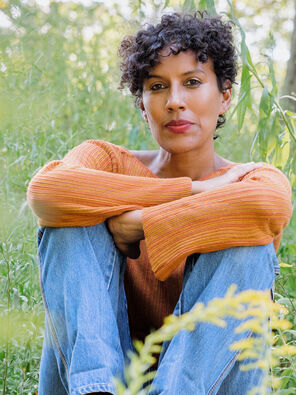
With those words, esteemed poet Cornelius Eady opens the envelope in his hands, exhales deeply, and touches his heart. The audience in The Town Hall in New York City erupts in cheers and applause, a bass player strikes up a jaunty melody, and Eady says the name seemingly everyone in the room seemed to already know: Aracelis Girmay, the Knight Family Professor of Creative Writing and professor of English in the School of Humanities and Sciences, and the poet behind this year’s prizewinner, Green of All Heads (Boa Editions, 2025).
The book is the result of nearly ten years of writing, not to mention a near-decade of lived experience that included the stroke and eventual death of the poet’s father; the births of her two children; and, of course, the COVID-19 lockdowns that kept all of us at home and in isolation. The award is something of a full circle moment for Girmay—she studied with Eady at the Cave Canem Fellowship retreats, corresponded with two of her fellow nominees over the course of the year when their books were published, and quoted one of those, Gbenga Adesina, in her acceptance speech.
“To see that [Eady] was the person who was going to announce the award was so beautiful,” Girmay said. “When I saw his reaction, I didn't know whose name he was responding to. I just thought, ‘Oh, how beautiful that people care for each other’s work in this way.’” Her friend sitting next to her at the ceremony, the writer Ellen Hagan, pinched her shoulder during that long pause between Eady opening the envelope and saying her name. “When they called the book name and my name, I was in shock.”
Deep loss and fugitive frequencies
Described by Publishers’ Weekly as “a nuanced meditation on loss and motherhood” and “moving and beautiful” and by The Rumpus as “shimmeringly surreal and existential,”
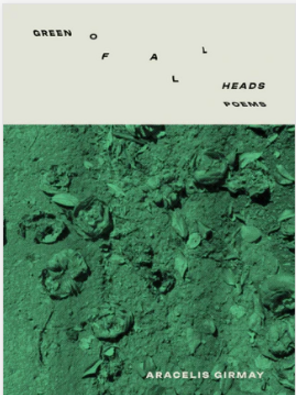
Green of All Heads collects the poetry Girmay wrote during a series of major life events. First came the birth of her first child. Just a few weeks later, her father endured a massive stroke. She had a second child before her dad passed away suddenly five years ago, and one of her dearest friends passed a year after that. All this was in addition to going through the pandemic and moving across the country for her job at Stanford, which she started in 2023. She credits the courage and brilliance of her students, as well as the additional time for her work afforded by the university, for some of the serious play required to finish the book.
“I was taking notes and writing things, but I wasn't thinking of them as poems,” she said of that time. “I was just trying to make a sound or image that helped me to feel like I could resuscitate my spirit or something. I was very disoriented in my making practice.”
Somehow, she found the ability to work again. “I became oriented toward a kind of quiet and jaggedness that felt meaningful and true to me,” she said. “The frequencies that I was reaching for were fugitive ones. I became interested in what might seem peripheral or across a threshold because that’s where so much of my thinking was. I tried to lie beside the beloveds who are now in their deaths while also raising the kids and trying to be alive for them. It felt like a much quieter, idiosyncratic, personal work—the privacies of mind and imagination were on my mind.”
The collection captures that sense of disorientation and loss, alongside love and sense of community. In the opening poem, “December,” Girmay writes about the fleeting nature of our lives and relationships:
Each of us, briefly, a tense
cast into the other’s time
In her acceptance speech, she alluded to the struggle to create, saying she was unsure if her “whisper of a book” would be “met by a reader.” From the glowing reviews, and now this award, it seems clear that it has been.
New undergraduate minor launches in civic thought and practice
Adrien Bilal selected for Time100 Next

Peter M. Ray, biologist with a passion for winemaking, has died at 94