Political scientist David Abernethy has died
Above: Professor David Abernethy speaks to the Faculty Senate during debate on the location of the Reagan Presidential Library.
An expert in African studies, he was also a leader in faculty governance.
David B. Abernethy, professor of political science, emeritus, in Stanford’s School of Humanities and Sciences (H&S), died January 30, 2026, at age 88. He suffered from motor neuron disease, with symptoms similar to ALS. As his world closed in on him, he chose to die in accord with California’s End of Life Option Act.
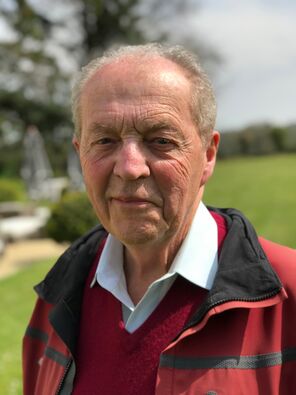
Abernethy spent his entire career at Stanford, teaching in the Department of Political Science from 1965 until retiring in 2002. A specialist in sub-Saharan Africa, he taught courses on politics in Africa, international development, and related topics.
Stanford Law Professor Hank Greely said of Abernethy: “He was long an adviser to me, both literally and figuratively. Literally, he was my freshman adviser when I appeared in Stern Hall in fall quarter 1970 and then became my departmental adviser during my political science major. Figuratively, he supported me in various interactions over the following decades but especially during my tenure as one of his successors as president of Stanford’s chapter of Phi Beta Kappa.”
Former student Chris Maloney, who went on to a career focused on economic development in Africa, described him as “a Stanford legend,” a brilliant professor who “could explain the complexities of colonialism and modern African politics in unusually accessible but nuanced ways, and he seemed to know the continent backward and forward.”
During his years at Stanford, Abernethy played a leading role in faculty governance, which he spoke about extensively in a 2017 oral history interview with the Stanford Historical Society. He chaired the Faculty Senate in the 1981–82 academic year, and in 1987, he was a leader in opposing a proposed hilltop location for the Ronald Reagan Presidential Library at Stanford that would dominate the campus. Due to overwhelming Faculty Senate opposition to that site, the library was built in Southern California. Abernethy’s university service also included chairing the African Studies Committee, co-chairing the Program in International Relations, and serving a term as president of the Stanford chapter of Phi Beta Kappa.
In 2004, Abernethy became a member of Stanford’s Emeriti/ae Council, which he chaired from 2006 to 2018. The council named its autobiographical reflections lecture series after him in 2019.
“He was a model citizen of the university, dedicated to truth and fairness,” said Iris Litt, professor of pediatrics, emerita, who succeeded Abernethy as chair of the Emeriti/ae Council. “With his death, we have lost a brilliant scholar, mentor, advocate for emeriti, and valued friend.”
Abernethy received many awards, including two H&S dean's awards for distinguished teaching, an H&S award for lifetime achievement in teaching, the Stanford Alumni Association's Richard Lyman Award for contributions to alumni, and the Lloyd W. Dinkelspiel Award for contributions to undergraduate education.
Steve Stedman, director of the Program in International Relations and a senior fellow at the Freeman Spogli Institute for International Studies, said the “magic sauce” that enabled Abernethy to leave a lasting impression on six decades of Stanford students contained “two major ingredients: helping students clarify what mattered to them and why and then providing robust encouragement in their work. Dave’s students and advisees learned about the world but, more importantly, they learned about themselves.”
Stedman said Abernethy's reputation as a caring mentor made the demand for office hours overwhelming. So in the 1990s, Abernethy created the Development Careers Group, a forum for undergrads and graduates to come together to discuss job possibilities and cutting-edge issues in development research. At times, the group included as many as 40 students, and alumni of the group would seek out Abernethy at every Reunion Homecoming weekend.
David Beaven Abernethy was born April 23, 1937, in Columbia, Missouri, to Bradford and Jean (Beaven) Abernethy. He earned undergraduate and doctoral degrees in government at Harvard University in 1959 and 1966, respectively, and a master’s in philosophy, politics, and economics at Oxford University in 1961. He married Julia Bourne Griffith in 1962, and they had two sons, Bruce and Brad. She died in 1978. He married Susan Getman Ross in 1980.
His published works include The Political Dilemma of Popular Education: An African Case (Stanford University Press, 1969) and The Dynamics of Global Dominance: European Overseas Empires, 1415–1980 (Yale University Press, 2000). For the latter, reviewer James Rosenau praised “the huge sweep of this balanced, elegant, and profound book.”
Abernethy played the violin, sang in the Stanford Symphonic Chorus, and attended orchestral and organ concerts. He wrote zany poems and was an inveterate punster. For many years, he read children’s stories, replete with exaggerated accents for the major characters, to students in a freshman dorm before finals week.
“Every December for 30 years, David came to Donner House, bringing his velvet baritone voice; his goofy, dramatic flair; his well-worn copy of Winnie-the-Pooh; and his mother’s precious copy of The Little Engine that Could,” said Linda Paulson, who has been the resident fellow at Donner for many years and also leads Stanford’s Master of Liberal Arts program. “David asked students to wear their jammies and bring their favorite stuffed animals—and they did. None of them will forget Professor Abernethy becoming one of the big engines that couldn’t, slipping out of his chair onto his back, wheels/legs turning in the air. They chanted with David, ‘I think I can. I think I can. I think I can.’”
Abernethy’s wife, Susan, and his sons Bruce and Brad and their wives were with him when he died. He is survived by them as well as four grandchildren.
A memorial service will be held at 3 p.m. on Wednesday, May 20, 2026, at Stanford’s Memorial Church.
H&S adds 20 new faculty members
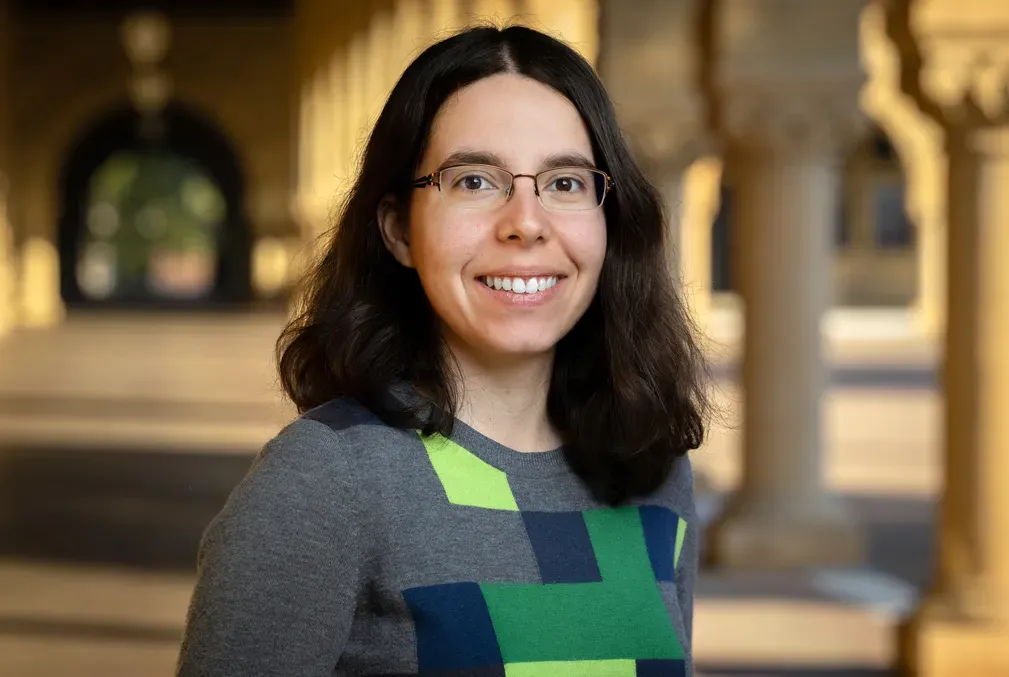
Sarah Peluse named Packard Fellow
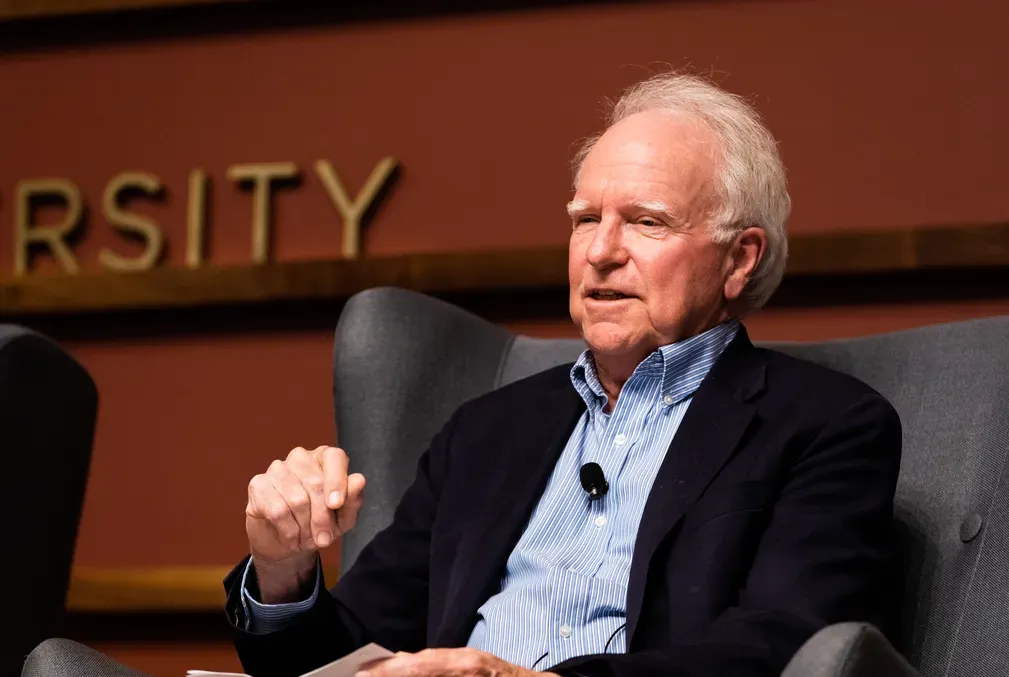
Robert E. Hall wins Nobel in economics