A tiny succession battle under an oak tree reveals ecological patterns
Insect larvae that feast on the acorns of oaks can also become food for fungi and microscopic worms. A Stanford-led study of their competition over this wriggling resource provides insights into “priority effects”—how the order and timing of different species shape biological communities.
An acorn from a coast live oak drops to the ground. Inside is the larva of a moth trying to grow into an adult insect, but other organisms nearby are also eager to eat the larva. What happens next in this miniature drama is helping scientists better understand “priority effects,” a succession among species that occurs in many ecosystems.

A team led by Stanford biologist Tadashi Fukami investigated how the larvae of the filbertworm moth and the filbert weevil, two insect species that eat acorns, are in turn killed and devoured by fungi and microscopic worms called nematodes.
The researchers discovered that none of the nematode species in this study could kill the insect larvae on their own. They needed the fungi to arrive first before they could gain entry to the carcasses. Surprisingly, one species of nematode, Oscheius, was able to eliminate the fungi that originally killed the larvae to have the spoils to itself.
“There are these really intricate interactions happening in this small world where communities are developing,” said Fukami, professor of biology in the Stanford School of Humanities and Sciences. “It’s clear that we can categorize these organisms into primary and secondary arrivals, and that categorization is significant because these kinds of peculiar microbial communities can be model systems for ecological succession.”
The study, published in the Federation of European Microbiological Societies’ journal FEMS Microbiology Ecology, focused on two insects that are known pests for hazelnut trees, an agriculturally important species, as well as oaks, but the researchers are looking at even wider implications.
Fukami and his colleagues are using this microcosm to study priority effects, which play a role in the development of all kinds—and sizes—of ecosystems. For instance, this process was likely a critical part of the rise of mammals on Earth after the majority of dinosaurs died off.
The world inside an acorn
Microcosms present a good opportunity to study priority effects because researchers can perform experiments and study multiple generations much more easily with smaller organisms.
This study took place within the larger ecological system of Jasper Ridge Biological Preserve ('Ootchamin 'Ooyakma), where Fukami is the faculty director. The research team including first author Amaury Payelleville, a former Stanford postdoctoral scholar, as well as several graduate and undergraduate students took acorn and soil samples from the coast live oak woodlands at the preserve. Their first goal was to discover what species were there and observe their interactions.
The filbertworm moth and filbert weevil lay their eggs in the acorns of oak trees. When the eggs hatch, the larvae start eating the acorns, which eventually fall, allowing the larvae to go into the soil to mature into adults—if they survive. From dead larvae, Fukami’s team identified the presence of two species of fungi, Metarhizium and Beauveria, as well as four species of nematodes: Acrobeloides, Mesorhabditis, Oscheius, and Rhabditis. They also saw that the nematodes tended to flourish in the wetter times of the year and were absent from dead larvae in drier months.


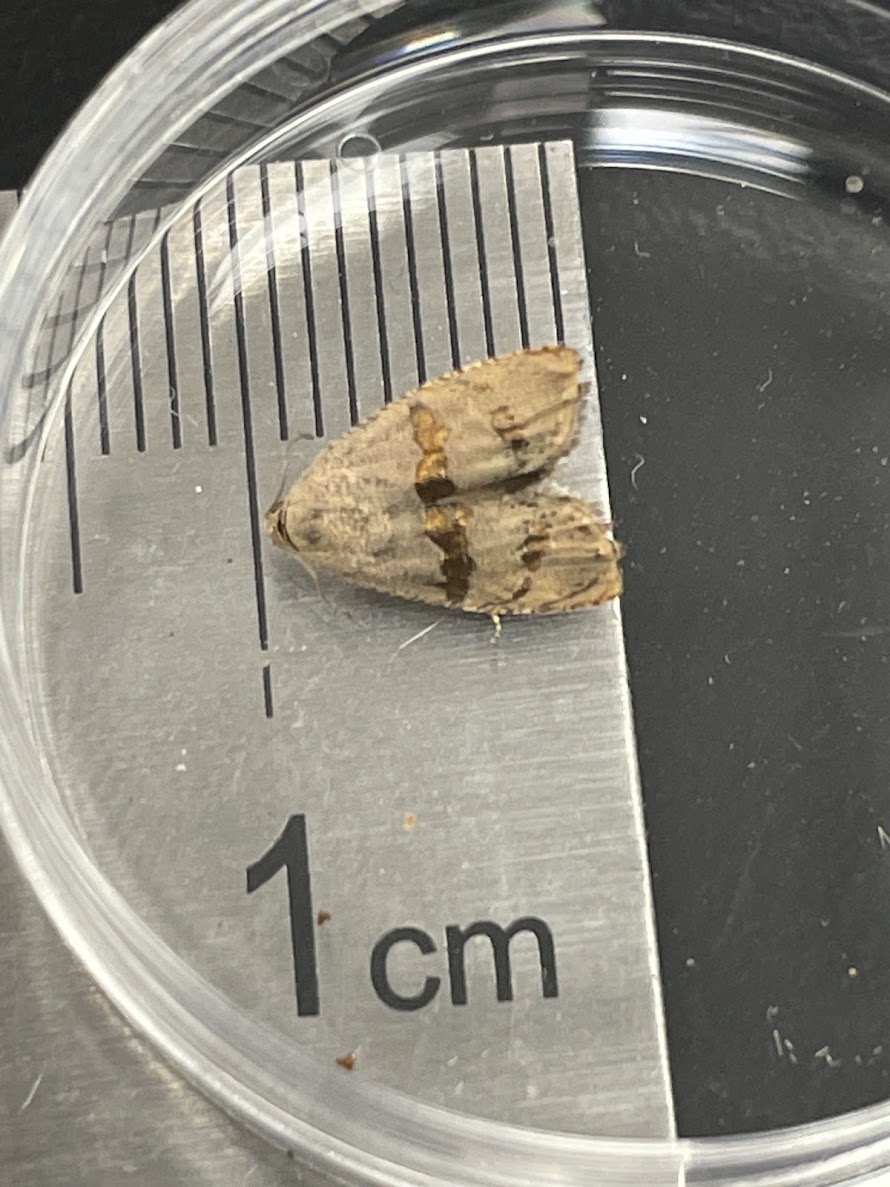
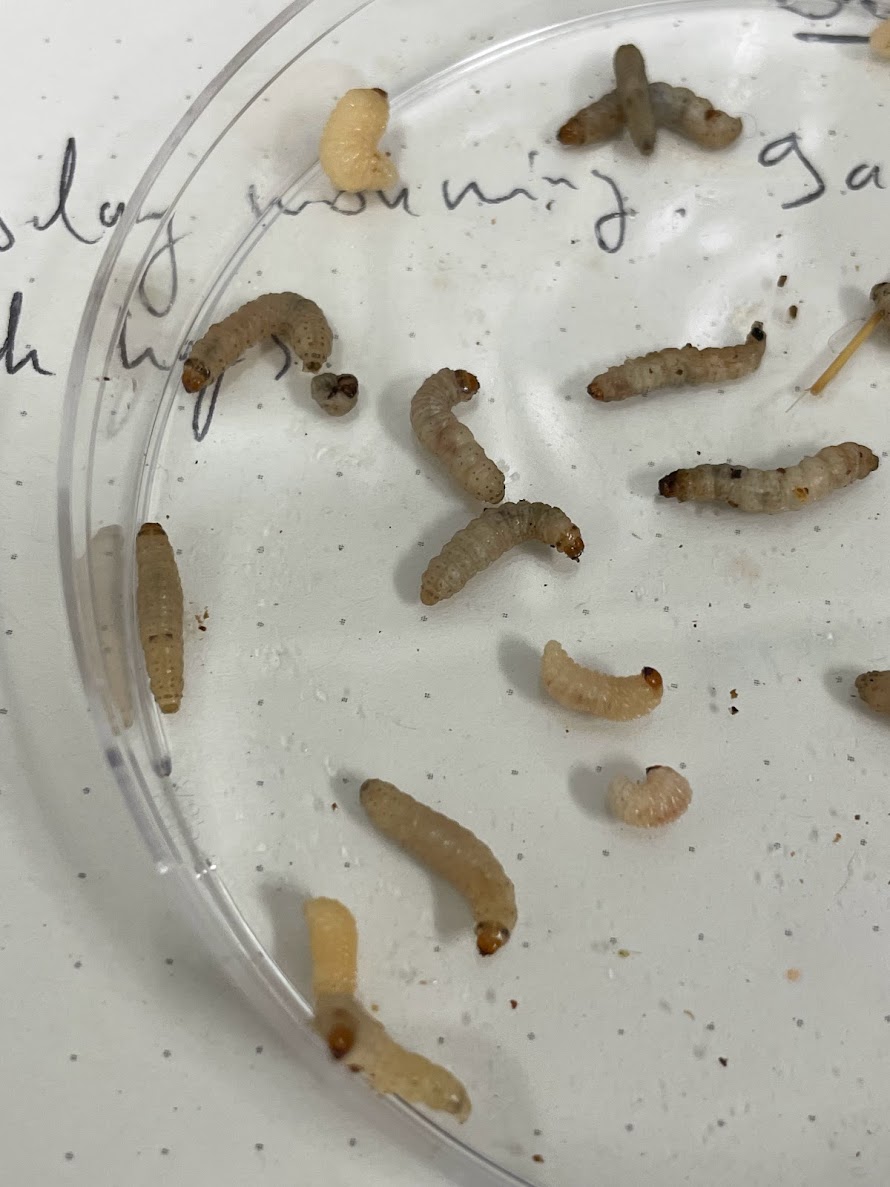
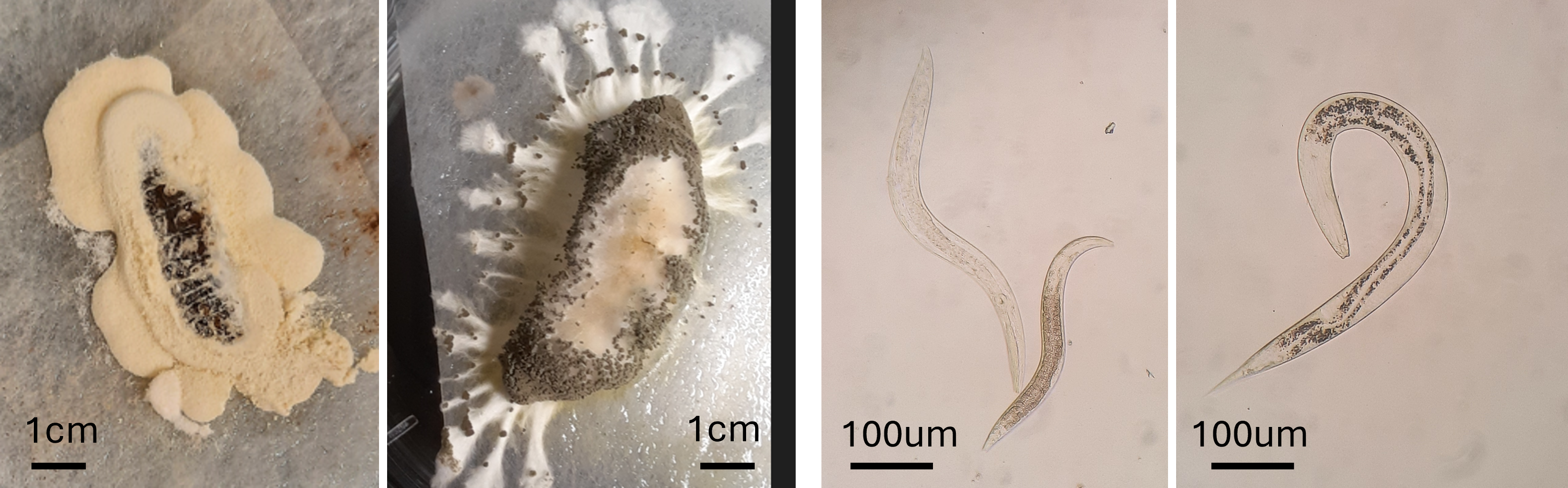
Researchers collected insects such as filbertworm moths (top left), filbert weevils, and their larvae (top right) to study in the lab and documented the fungi (bottom left) and nematodes (bottom right) that emerged. Photos by Tadashi Fukami and Amaury Payelleville.
After observing the patterns of when the different species appeared, the researchers then conducted some experiments in the laboratory, isolating and then combining two or more of the species to see how they interacted to obtain the resources of the larvae. They found a strong priority effect, essentially that the fungi had to arrive first in the larvae before the nematodes could gain access.
They also found that after Oscheius nematodes entered a dead larva, they had the ability to kill off the Beauveria fungus that was already there. The researchers later discovered Oscheius carries symbiotic bacteria that gives off antifungal and antibiotic chemicals, adding another layer to the species’ interactions. The research team is now exploring how the different types of symbiotic bacteria carried by nematodes aid the worms in their competition for resources.
The current study illuminates just a small part of these host–parasite interactions, and more research is needed to understand the many complicated relationships among species, Fukami said.
“Even in this very small place, there’s so much that we don’t know,” he said.
Acknowledgments
Fukami is also a professor of Earth system science in the Stanford Doerr School of Sustainability.
Additional Stanford co-authors include Christine Jacobs-Wagner, the Dennis Cunningham Professor and professor of biology in the School of Humanities and Sciences as well as professor of microbiology and immunology in the School of Medicine; Magdalena Warren, a former biology doctoral student; Chloe Golde, a biology doctoral student; and biology undergraduate students Patrick Cleary, Arizbel Gomez, and Devyn Sasai. Rubina Shrestha, a master’s student in computer science, and Benny Pan, an undergraduate student in computer science, also collaborated on the paper.
Co-authors also include researchers from the Université de Montpellier in France.
This work was supported by a Discovery Grant from the Stanford Doerr School of Sustainability.
Media contact:
Sara Zaske, School of Humanities and Sciences, 510-872-0340, szaske [at] stanford [dot] edu (szaske[at]stanford[dot]edu)

H&S adds 20 new faculty members
Sarah Peluse named Packard Fellow

Robert E. Hall wins Nobel in economics